
Last reviewed: 27 July 2026. Airbnb changed this system in October 2025. If you are reading a guide that mentions a "Strict" policy as a current option, it is out of date.
What changed in October 2025
The headline: Airbnb retired the Strict cancellation policy.
From 1 October 2025, new listings can no longer select Strict. Existing listings that used it were migrated to Firm, with hosts given the opportunity to opt out before the change took effect. Super Strict 30 and Super Strict 60 remain, but they are invitation-only and always were.
A Limited policy was introduced alongside this, and a universal 24-hour grace period now sits on top of every standard policy.
So the current system has two layers: a grace period that applies to everything, and one of four tiers that the host chooses.
The 24-hour grace period
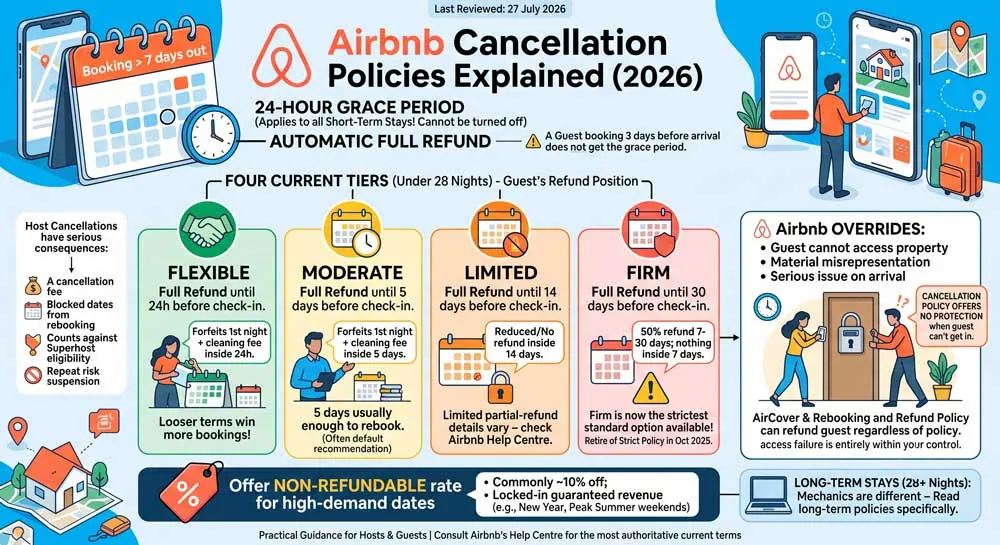
This applies to every booking under 28 nights, on every policy tier, and hosts cannot turn it off.
If a guest books at least seven days before check-in, they can cancel within 24 hours of booking for a full refund, automatically.
The seven-day condition matters. A guest booking three days before arrival does not get the grace period.
The four current tiers
For stays under 28 nights. All figures are the guest's refund position.
| Policy | Full refund until | Between that and check-in |
|---|---|---|
| Flexible | 24 hours before check-in | Guest forfeits the first night and the cleaning fee |
| Moderate | 5 days before check-in | Guest forfeits the first night and the cleaning fee |
| Limited | 14 days before check-in | Reduced or no refund inside 14 days |
| Firm | 30 days before check-in | 50% refund between 7 and 30 days; nothing inside 7 days |
Firm is now the strictest standard option available.
Reported details differ slightly between sources on the exact partial-refund behaviour of Limited, and the mechanics of unspent nights on Moderate. Check Airbnb's own policy pages for the precise figures before you rely on them commercially.
Which to choose
The genuine question is not "which is safest" but how quickly your calendar refills.
Flexible or Moderate suits fast-rebooking urban markets. A cancellation ten days out is annoying rather than costly if you can refill it. Looser terms also win more bookings, and Airbnb reportedly found that listings migrated from Strict to Firm earned around 10% more on average because the looser terms converted better.
Limited or Firm suits seasonal and hard-to-rebook properties. If losing a peak week means an empty week, you need real protection.
Moderate is the common default recommendation, because five days is usually enough to rebook while still reading as reasonable to guests.
New listings generally do better starting looser, because the first priority is accumulating reviews.
The non-refundable option
Separate from your tier, you can offer a non-refundable rate at a discount, commonly around 10%. The guest gets the lower price and forfeits the accommodation fee entirely if they cancel.
This is a useful tool for your highest-demand dates specifically: New Year, local events, peak summer weekends. You lock in guaranteed revenue on the dates you least want to lose.
Stays of 28 nights or more
Longer stays run on separate long-term policies, and the mechanics are different enough to catch people out.
Under the default long-term Firm policy as commonly described: if a guest cancels within 30 days of check-in, they pay for the first 30 nights. If they cancel after check-in, they pay for the nights spent plus a further 30.
If you operate mid-term or corporate stays, read the long-term policies specifically rather than assuming your short-stay tier carries over. It does not.
What Airbnb can override
Your chosen policy is not absolute. Two things sit above it and hosts cannot switch them off:
The 24-hour grace period.
The Rebooking and Refund Policy, part of AirCover for Guests. Where a guest cannot access the property, the listing is materially misrepresented, or there is a serious issue on arrival, Airbnb can refund the guest regardless of your cancellation terms.
That second one is worth sitting with, because the most common trigger is straightforward: the guest could not get in. A failed lockbox code, a key that was not where it should be, a host who did not answer the phone at 11pm. Your cancellation policy offers no protection against that at all, because the fault is on your side.
If the host cancels
Host cancellations are treated seriously and the consequences stack.
- A cancellation fee, scaling with proximity to check-in, reported as starting at a $50 minimum
- The dates are blocked from rebooking, so you cannot cancel one booking to take a better one
- It counts against Superhost eligibility
- Repeat cancellations risk account suspension
- Documented emergencies are exempt under Airbnb's coverage policies
The practical takeaway: do not accept bookings you are not confident you can honour.
Practical guidance for hosts
Set it deliberately. A great many hosts are currently on Firm only because they were migrated there in October 2025, not because they chose it. That may or may not suit your market.
Match your rebooking reality, not your anxiety. Stricter is not automatically better. It costs you bookings.
Layer non-refundable rates on peak dates rather than tightening your whole calendar.
Read the long-term policies separately if you take 28-plus-night stays.
Fix the access problem before you optimise the policy. No cancellation tier protects you from a refund triggered by a guest who could not get through the door.
Practical guidance for guests
- You almost always have 24 hours to change your mind, if you booked at least a week out
- Check the policy before booking, not after. It is shown on the listing
- A non-refundable rate is genuinely non-refundable
- If something is seriously wrong on arrival, or you cannot get in, raise it with Airbnb immediately through the platform rather than leaving and arguing later. The Rebooking and Refund Policy is time-sensitive and documentation-dependent
- Stays of 28 nights or more work differently
Where to check the current rules
Airbnb's Help Centre is the only authoritative source for this. These are the company's own product terms, they change without notice, and every third-party guide including this one is a snapshot.
Search Airbnb's Help Centre for "cancellation policies for your listing" for the host view and "cancelling a reservation" for the guest view, and check the AirCover and Rebooking and Refund Policy pages separately.
A note on the access problem
We are a key exchange company, and we notice which refunds are avoidable.
Cancellation policy protects you against a guest changing their mind. It does nothing when a guest arrives, cannot get in, and Airbnb refunds them under the Rebooking and Refund Policy. That is a different category of loss, and unlike a cancellation, it is entirely within your control.
If your check-in depends on a code that might not work or a person who might not answer, that is the gap worth closing first. Here is how we handle it.
This article is general information, not legal, tax or financial advice. Airbnb's cancellation policies are the company's own commercial terms and change without notice. The figures here reflect publicly reported details at the time of writing and sources disagree on some specifics. Always confirm the current position in Airbnb's Help Centre before making commercial decisions or booking travel.