
In the real estate sector, the growth of a property portfolio brings new opportunities, but also new operational challenges. The more properties a real estate agency, a rental management company, or a concierge service handles, the more complex daily coordination becomes: organizing visits, managing technical interventions, assisting tenants, meeting owner expectations... and maintaining control over access to different properties.
Among these challenges, key management is often considered a logistical detail. However, it is a central element in the operation of a real estate business. Each key represents access to a property entrusted by an owner, and every movement must be trackable, secure, and easily identifiable.
This is an observation shared by many professionals in the sector, notably by Julien Raynaud, director of L’Agencerie, a network of independent real estate agencies located in the south of France. Faced with these issues, his team chose to digitize its key management with Keycafe. In this article, we revisit this experience: the challenges encountered before implementation, the operational changes after adoption, and the concrete benefits observed daily, through the insights shared by Julien Raynaud during his interview.
The growth of a real estate business implies a new organization
When launching a real estate business, key management often relies on simple processes: physical storage, a tracking board, or a key handover logbook.
These methods can work when the volume of properties remains limited. But as the number of mandates increases, flows become more difficult to manage. Keys pass through the hands of multiple collaborators, service providers, and external stakeholders, making their tracking increasingly complex.
At L’Agencerie, this issue naturally emerged with the agency's growth.
“As the agency evolved and grew, we were led to manage more and more files, whether for transactional activities or rental management,” explains Julien Raynaud.
“Managing more and more files, necessarily, for us, as real estate agents, means managing keys. On the transactional side, with the increasing number of collaborators, we needed to know who held the key, where that key was, who had it, and to whom it was given.”
This question becomes even more important when multiple people need to access the same property.
The limits of traditional key tracking methods
For a long time, many real estate companies used simple solutions like mechanical key safes or paper registers. While these tools allow for physical centralization of keys, they do not always provide a clear overview of their usage.
The problem is not just knowing where a key is, but knowing:
Who picked it up;
When it was taken out;
Why it was used;
When it needs to be returned.
Before adopting a digital solution, L’Agencerie operated with a classic key safe combined with manual tracking.
“At the time, we used a fairly standardized key safe, but unfortunately, without very precise tracking, other than a paper logbook,” says Julien Raynaud.
“This mostly led us to spend long hours searching for where that key was, who was the last collaborator to have touched it, and to whom we had handed it over.”
In a business where responsiveness is essential, this time spent searching for information represents a real operational inefficiency.
Access management becomes a real estate coordination challenge
Today, property management involves numerous stakeholders. An agency may need to organize visits with different collaborators, allow artisans to intervene, coordinate maintenance operations, or facilitate access for trusted service providers.
Each intervention requires temporary access to the property, but this access must remain controlled.
Julien Raynaud particularly emphasizes this difficulty in the context of rental management:
“In the context of rental management, we encounter the same problems with the intervention of third parties. I am thinking, in particular, of artisans, plumbers, electricians, and gardeners who may intervene occasionally on certain houses we manage.”
Without a structured process, these multiple interactions can quickly become difficult to supervise.
A digital key management solution precisely provides this visibility by associating each key with a property, a user, and a specific action.
Digitizing key management to professionalize operations
Digitalization is not simply replacing a traditional safe with connected equipment. Above all, it allows for the creation of a clear process around access.
At L’Agencerie, each key is now registered with the necessary information before being made available to the teams.
“As soon as a client – whether an owner, seller, or landlord – hands over the keys to us so we can conduct visits to their property, at that moment, we log the keys into Keycafe,” explains Julien Raynaud.
The team then associates each key with the information of the relevant property to facilitate its identification.
“We of course enter who this key belongs to, the number of keys, and also the address of the property in the software.”
This organization allows authorized collaborators to quickly access the correct keys, without relying on a colleague or a manual register.
Better traceability for greater security and trust
In property management, traceability is not just a matter of internal security. It also contributes to the relationship of trust between the agency and its owner clients.
Entrusting keys to an agency means entrusting access to a property that is sometimes very significant financially and emotionally. Demonstrating that these accesses are managed rigorously therefore becomes a real differentiating factor.
For Julien Raynaud, this dimension was essential:
“It is also a way for us to show our clients that we are very vigilant about the use of their keys.”
The visibility provided by a digital solution also helps empower teams.
“The big advantage is that we can tell in real time who holds the key. If it's an external service provider, we know when they need to return it.”
This ability to track key movements reduces uncertainties and facilitates coordination between different stakeholders.
Easy-to-adopt tools for real estate teams
One of the common barriers to adopting a new tool is complexity of use. However, according to L’Agencerie, the transition to digital key management can be very fast.
“Once the procedure has been explained to all collaborators, implementation is quite intuitive and easy,” explains Julien Raynaud.
The team did not encounter any particular difficulty in adopting the solution:
“There was no real problem or reluctance encountered by the collaborators, quite the contrary.”
This simplicity is particularly important in a real estate environment where collaborators are often mobile and need quick access to necessary information.
Less time lost, more peace of mind daily
Beyond security, the main objective remains to improve operational efficiency.
For L’Agencerie, the most visible benefit has been the reduction in time spent searching for and manually tracking keys.
“We no longer spend time searching for where the keys are. That's a huge advantage. Everything is centralized, everything goes much faster.”
This improvement allows teams to focus more on their core business: assisting owners, organizing transactions, and ensuring better service quality.
As Julien Raynaud summarizes:
“It's clearly a very interesting tool for daily use.”
Key management, a performance driver for real estate professionals
As real estate activities evolve, management methods must also evolve. Professionals no longer just manage properties: they manage client experiences, teams, service providers, and complex processes.
In this context, access management becomes a real performance driver.
Structuring key management allows for:
saving time in daily operations;
securing property access;
improving coordination among stakeholders;
strengthening owner trust.
For Julien Raynaud, the investment in a dedicated solution is justified by the operational benefits it provides:
“I preferred to consider that the cost required for the implementation and operation of the solution was outweighed by the time saved and the peace of mind I could bring to my collaborators.”
In a sector where every detail matters, better managing access also means better managing properties.

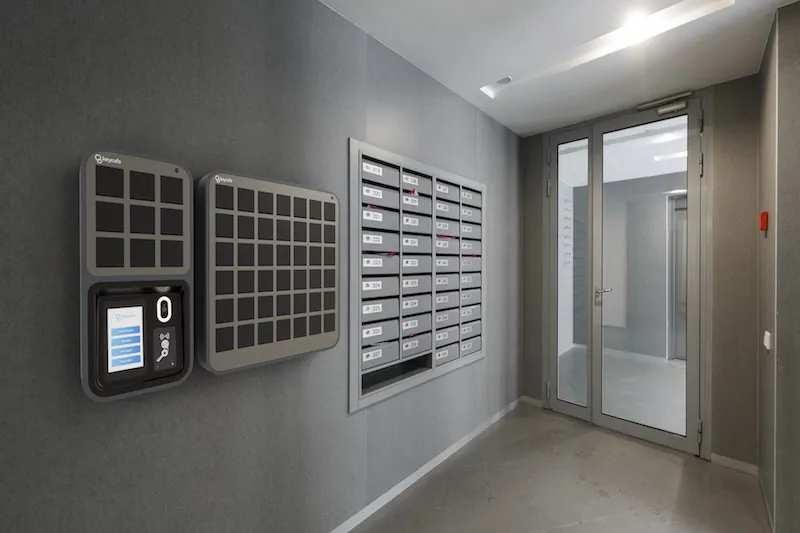
Grâce au suivi en temps réel des mouvements de clés, les agences peuvent identifier qui détient un accès, responsabiliser les utilisateurs et mieux contrôler les interventions sur les biens confiés par les propriétaires.