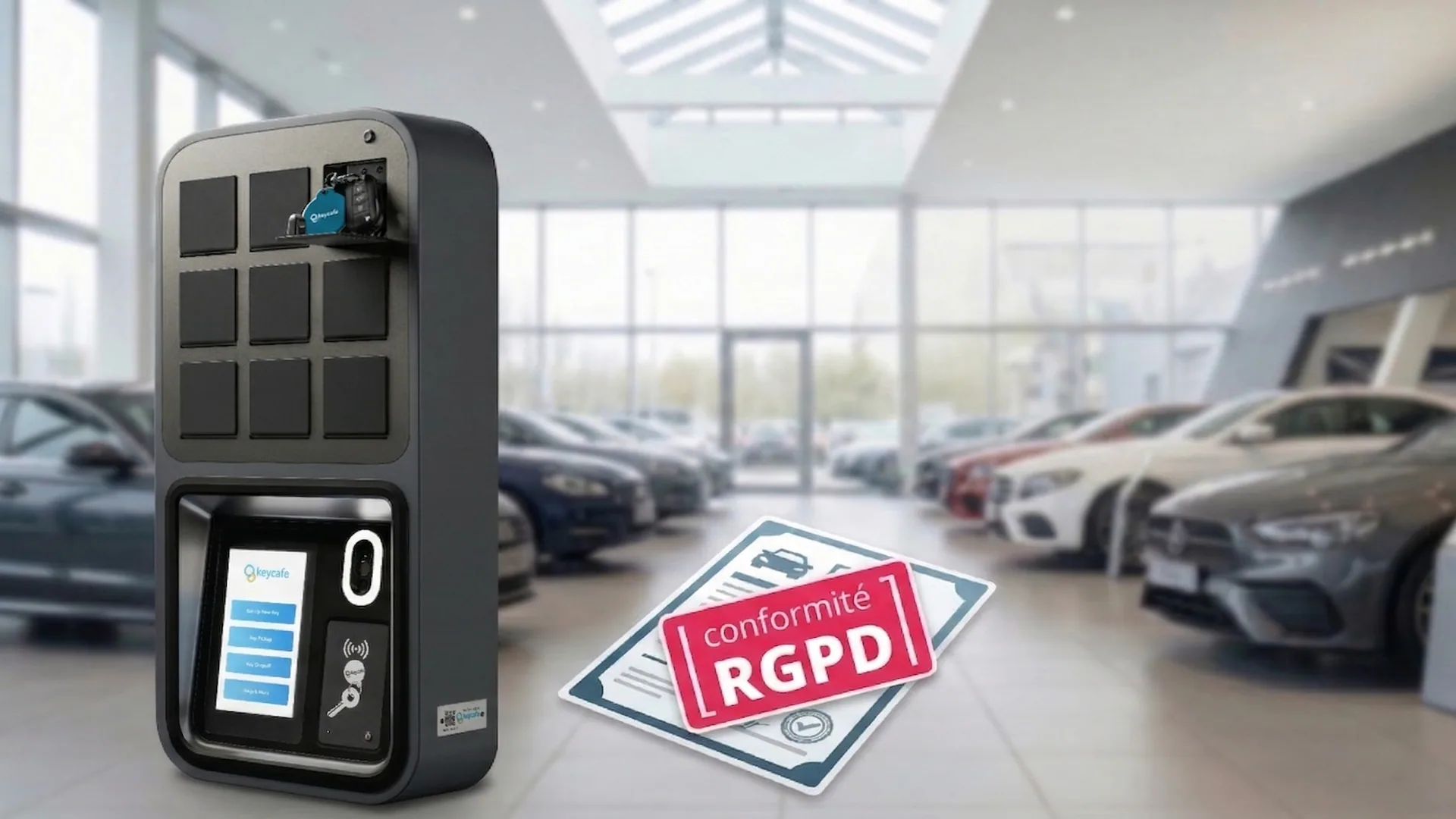

In 2026, key management is becoming a GDPR compliance issue. Personal data protection is no longer limited to IT systems. With the GDPR coming into force and controls being strengthened, companies must now adopt a global security approach — encompassing both digital and physical access.
In car dealerships, this evolution highlights an element long considered secondary: vehicle key management.
Because today, a key doesn't just grant access to a vehicle. It is indirectly linked to a set of sensitive data: customer information, sales records, usage history, and technical interventions. Poor key management can thus become a loophole in personal data protection.
In other words, physical access management is now inseparable from GDPR compliance.
When Physical Access Becomes a Data Risk
Contrary to popular belief, security breaches don't always stem from complex cyberattacks. In the reality of dealerships, incidents are often linked to everyday practices that are common but risky.
A key left unattended without control, access granted without time limits, or a service provider keeping an untracked duplicate are all situations that can compromise security. Each key then becomes a potential entry point to a vehicle, but also to the data associated with it.
The GDPR, however, imposes a fundamental principle: all personal data must be protected against unauthorized access. This implies not only securing IT systems but also perfectly controlling who can physically access company assets.
The GDPR Imposes a Logic of Proof, Not Just Protection
One of the major changes introduced by the GDPR lies in the obligation of demonstration. It is no longer enough to implement security measures; their effectiveness must be provable.
For a dealership, this means being able to precisely trace the history of vehicle access. Who used a key? When? In what context? Was it for a customer test drive, a maintenance operation, or delivery preparation?
Without a structured system, this information is often fragmented, or even non-existent. In the event of an audit or incident, this lack of visibility can quickly become problematic, both legally and operationally.
Compliance therefore rests on three implicit pillars: traceability, control, and the ability to produce reliable evidence.
The Limitations of Traditional Dealership Methods
Despite these increasing demands, many dealerships continue to rely on key management methods that are no longer suitable.
Unsecured physical cabinets, spreadsheet tracking, or informal exchanges between employees create an illusion of control but fail to guarantee real security. In these configurations, a key's accountability quickly becomes blurred, especially when it circulates between multiple departments.
This lack of reliable traceability makes any analysis difficult in case of a problem. It also complicates GDPR compliance, which requires a clear and documented view of access.
As operations become more complex — increasing number of vehicles, team rotation, external interventions — these limitations become increasingly critical.
Digitizing Key Management: A Concrete Response to GDPR Requirements
Faced with these challenges, the digitalization of key management emerges as a structuring solution.
The goal is not only to physically secure keys but to transform every interaction into actionable data. Thanks to connected systems, it becomes possible to centralize keys in secure cabinets while automatically recording every action.
Each key retrieval or deposit is associated with an identified user, a precise timestamp, and a usage context. This automation eliminates approximations and oversights associated with manual tracking.
Beyond traceability, these solutions also allow for better access control. It becomes possible to define specific, time-limited authorizations tailored to each individual's role. An employee, technician, or external service provider only accesses the keys they need, for a strictly defined duration.
This level of granularity significantly reduces the risks of unauthorized access.
Conclusion: Key Management at the Heart of Compliance and Performance
The GDPR has profoundly transformed how companies must approach security. In car dealerships, this transformation notably involves better control over physical access.
Key management is no longer a mere logistical task. It becomes a strategic lever, both for ensuring regulatory compliance and for improving operational performance.
Dealerships that can anticipate these challenges and adopt suitable solutions will not only meet GDPR requirements. They will strengthen their organization, secure their processes, and gain efficiency.
Because in 2026, controlling your access also means controlling your risks.
About Keycafe
Keycafe is a smart key management solution that allows car dealerships to secure, control, and track all access to their vehicles. Thanks to a connected platform and secure cabinets, Keycafe helps professionals simplify their operations while ensuring optimal compliance with GDPR requirements. Do you want to secure key management in your dealership and ensure your GDPR compliance? Learn more here!