
The way people work and live has continued to evolve since coworking and coliving first entered the mainstream. Hybrid schedules, return-to-office policies, distributed teams, and the steady rise of digital nomadism have turned what were once niche real estate categories into permanent fixtures of the urban landscape. With that growth has come a parallel shift. The physical key, once central to managing access, is increasingly being replaced or augmented by mobile credentials, cloud-based platforms, and integrated proptech.
This post updates an earlier piece on key management for shared spaces with current market data, recent trends, and where the industry seems to be headed in 2026.
A quick note on the numbers
Market-size estimates for coworking and coliving vary widely depending on how each analyst defines the category, with purpose-built coliving versus broader shared housing, and dedicated coworking versus all flexible-office formats producing very different totals. The figures below are pulled from named industry sources, but readers should treat any single market-size number as one estimate among many rather than a definitive figure.
The shared-space market in 2026
Flexible workspace is no longer a side category. It has become a structural part of office demand. According to Cushman & Wakefield's Global Flexible Office Trends 2025 report, 55% of global occupiers now use flex space, with another 17% planning to increase their use, and JLL projects that 30% of all U.S. office space will be consumed flexibly by 2030.
The U.S. footprint has scaled accordingly. As of Q3 2025, there were roughly 8,420 coworking locations across the country, and the average coworking space offers about 90 desks across 13,000 square feet of space. Manhattan leads with 287 locations and 12 million square feet, followed by Los Angeles at 322 locations and 7.2 million square feet, while secondary markets such as Denver, Raleigh–Durham, Phoenix, and Houston continue to gain ground.
Consolidation is reshaping the operator landscape. In January 2025, CBRE Group acquired Industrious in a transaction valued at approximately $400 million, folding the operator into a new Building Operations & Experience segment.
Coliving has matured along similar lines. Industry analysts now describe coliving as a recognized real estate asset class, with a global market approaching $20 billion and growth rates exceeding 20% annually. In the U.S. specifically, the coliving market is valued at approximately $4.2 billion in 2025, concentrated in cities where housing affordability has become a chronic problem, including New York, San Francisco, Los Angeles, and Austin. A signal of where the sector is going: Habyt and Common merged in January 2023 to form an entity managing more than 30,000 units across 40 cities and 14 countries.
The customer base is also broader than the early stereotype. MBO Partners' 2025 study found that the number of U.S. digital nomads has grown 153% since 2019 and now represents roughly 12% of the American workforce. That's a population that lives, works, and travels in ways that favor flexible spaces with frictionless access.
Why traditional key management struggles in shared spaces
In any building with constant turnover, physical keys create predictable friction:
High member or resident churn means frequent re-keying and unclear chains of custody
After-hours and 24/7 access requires staff coverage or pre-distributed keys
A lost master key can mean re-keying every affected door
There is no real audit trail, so operators take people's word for who came and went
These aren't theoretical issues. About 60% of operators cite rising operational costs and inflation as their most challenging market condition, and the staff hours absorbed by key cabinets, lockouts, and manual handovers are exactly the kind of cost that newer access systems are designed to eliminate.
The shift toward smarter access control
The bigger story isn't just better key cabinets. It's that "where is the physical key?" has been replaced by "who has permission, on what device, for which window of time?"
By 2026, keycards in higher-end coworking spaces have largely become relics, with operators globally adopting mobile-app and smart-credential entry systems built on platforms that integrate with coworking management software.
Recent industry data supports the shift:
Parks Associates' 2025 multifamily report found that 24% of multifamily owners and operators now use smart building technology, and more than 59% of renters prefer properties with mobile access control.
In a coliving-specific dataset cited by market research firms, smart-access technology adoption reportedly reached around 68% of coliving properties by 2024 (this is one of several estimates floating in the sector and worth treating as directional rather than precise).
Roughly 32% of organizations already use mobile identities, and 73% of access-control end users and industry partners consider mobile IDs a top priority.
Mike Green, Senior Offering Manager for Mobile Solutions at LenelS2, described 2025 as the year of the mobile credential, particularly NFC wallet–based solutions.
What modern access systems actually do
Today's cloud-based access platforms do considerably more than open doors. The capabilities most consistently cited across vendors and analyst writeups include:
Cloud-based remote management. Admins grant or revoke access from anywhere in real time. Automation enables onboarding and offboarding so that new members are granted access the moment they join, and departing members lose access instantly, eliminating gaps in security.
Real-time logging and analytics. Every access event is timestamped, providing an audit trail and usage data that operators can feed into pricing, layout, and staffing decisions. About 67% of coworking space operators use, on average, four different technology tools to run their business, and access logs are increasingly important inputs into how those tools talk to each other.
API integrations with property management and booking software. This is where the operational leverage lives in larger spaces. When a member books a meeting room, that room's door (or the key to it) becomes available during the booked window with no staff intervention. When a coliving lease ends, building access is automatically revoked across every door it covered.
Touchless and biometric options. Biometric solutions using fingerprints or facial recognition tend to be reserved for higher-security zones rather than every door, balancing protection with cost and privacy considerations.
AI-driven anomaly detection. Newer platforms can flag unusual access patterns and alert operators before incidents escalate, including repeated denied entries at odd hours, badge sharing, or doors propped open.
The hidden cost of going fully digital, and a smarter middle path
There is one important wrinkle that often gets glossed over in articles like this. Going from physical keys to a fully digital, smart-lock-everywhere setup is genuinely expensive. Every door needs new hardware, often new wiring or batteries, network coverage, and integration into the management platform. In a multi-floor coworking building with private offices, conference rooms, mail rooms, IT closets, storage, equipment cabinets, vehicles, and shared amenities, you can easily be looking at hundreds of access points. Multiply that by the cost of smart hardware and installation, add the time the spaces are partially out of service during deployment, and the bill adds up quickly.
Most operators don't actually need every door to be a smart lock. They need to know who has access to what, when, and to be able to change that quickly. This is where Keycafe fits in.
How Keycafe reduces cost without giving up the digital feature set
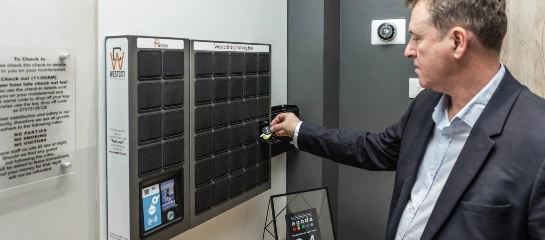
Keycafe takes a different angle on the problem. Instead of ripping out every lock and replacing it with smart hardware, Keycafe lets operators keep the physical keys, fobs, and access cards they already use, and puts the intelligence around them in a cloud-connected SmartBox. The keys stay physical. The management layer becomes fully digital.
In practice, this means coworking and coliving operators can deploy Keycafe in a fraction of the time and at a fraction of the hardware cost of a full digital-lock overhaul, while still getting the feature set the industry is asking for:
Cloud-based permissions and remote management. Add, revoke, or schedule key access in real time from a desktop or mobile app, down to the minute.
Full audit trail. Every key pickup and drop-off is logged automatically, with optional photo ID verification at the SmartBox so there's no ambiguity about who took which key.
Robust API. The Keycafe API exposes endpoints for users, keys, bookings, exchanges, and SmartBoxes, so operators can wire key access directly into their member management, booking, or PMS systems. When a booking is created, a key pickup code can be issued automatically. When a member's plan ends, their permissions can be revoked through the same workflow that handles billing.
Integrations with hospitality and rental platforms. Out-of-the-box integrations with Mews, Hostaway, and Fleetio cover hotels, short-term rentals, and fleet operations, which overlap heavily with coliving and coworking-with-amenity setups.
Multi-site support. Operators running several locations can manage all of them from one account, with features like Key Roaming to control which keys can be returned to which sites.
SSO and modern auth. Google and Microsoft single sign-on are supported, alongside QR-code authentication at the SmartBox.
Offline-resilient. SmartBoxes support offline key pickup during internet outages, so a connectivity hiccup doesn't lock anyone out of the building or amenity.
Scales with the space. A SmartBox can be configured for a single key or several thousand keys, with capacity added as the operator grows.
Predictable, flat monthly pricing. Keycafe charges a fixed monthly fee per location regardless of whether you're managing 9 keys or 400, which is unusual in an industry where most digital access systems scale cost per door or per credential. For shared-space operators, that means key inventory can grow with the business without the access-management bill growing alongside it.
The practical upside for shared-space operators is straightforward. You get cloud-based access control, real-time logging, API automation, and integration into your existing software stack, but you keep working with the locks and keys you already have. Deployment can happen in days rather than the weeks or months a building-wide smart-lock retrofit can require, the upfront capital outlay is dramatically smaller, and the ongoing cost is predictable rather than scaling with every new key or door. Given that 60% of operators cite rising operational costs as their biggest market challenge, having an access-management line item that doesn't balloon as the space grows is a meaningful operating advantage. For operators who want the modern operational benefits without disrupting tenants or stripping out working hardware, this is often the more sensible starting point, and in many cases it ends up being the long-term answer rather than a stepping stone.
It also pairs well with smart locks where they genuinely add value. A coworking operator might use mobile credentials at the front door and conference rooms while running Keycafe for office keys, mailbox keys, storage, and shared vehicles. The two approaches aren't mutually exclusive, and treating them as a hybrid stack often delivers better economics than going all-in on either one.
Where this is heading next
A few trends worth watching through 2026 and beyond:
Security as an amenity. In secondary and tertiary U.S. markets, the coworking provider's security stack increasingly functions as the region's shared cybersecurity infrastructure for small businesses, bundling physical access control, segmented Wi-Fi, and monitoring into the monthly fee.
AI in operations. Industry analysts expect AI to move from buzzword to operational backbone by 2028, with most professional coliving operators using it for dynamic pricing, predictive maintenance, automated resident matching, and chatbot-first communication. Access data is one of the cleanest inputs feeding these models.
Institutionalization favors standardization. As institutional capital flows into both coworking and coliving, investors are demanding standardization, real-time reporting on occupancy and maintenance, and digital audit trails. The era of running hundreds of doors out of a spreadsheet and a key cabinet is, practically speaking, over.
Hybrid stacks become the default. Rather than choosing between smart locks and smart key cabinets, operators are increasingly running both. Mobile credentials cover high-traffic perimeter doors and amenity spaces, while cloud-managed key systems handle everything else.
Bottom line
Coworking and coliving have moved from experimental to institutional, and access control has moved with them. The destination is the same regardless of which path operators take: get the right people into the right spaces at the right times, with a clear record of what happened.
What's changed is that the choice is no longer "old-school keys" versus "expensive full digital retrofit." Cloud-connected key management systems like Keycafe make it possible to bring physical keys into the modern access-control era without the cost and disruption of replacing every lock in the building. For most shared spaces, that's the practical version of what the industry has been calling smart access all along.