
Barcelona is the only city in this series with a published end date.
In June 2024 the city council announced that none of the roughly 10,100 existing HUT tourist-use licences would be renewed. They expire by November 2028. Spain's Constitutional Court upheld the plan in March 2025, dismissing challenges from owners and platforms. No new HUT licences have been issued since the 2014 moratorium, and the PEUAT planning framework reinforced the freeze in 2017. Existing licences cannot be renewed and transfer only with a complete property sale.
From 2029, whole-apartment tourist letting under 31 nights in residential buildings will not have a legal route inside the city limits. Licensed hotels, hostels and aparthotels in dedicated commercial buildings sit under a different regime and are not part of the phase-out.
That is roughly two and a half years of runway, and it converts every operational decision into a capital allocation question. Not "does this improve the business" but "does this still have a use in 2029?"
Two and a half years is a long time and a short time
Both things are true, and Barcelona operators are split on which matters more.
It is a long time in the sense that the market is still working. Occupancy and rates in the city remain among the strongest in Europe, and licensed operators have several more seasons of trading ahead. Walking away now means leaving real money on the table.
It is short in the sense that anything you buy today needs to earn out before the model ends, or be transferable to whatever comes next. A five-year payback on a tourist-letting-specific investment does not clear that bar. A software subscription tied to nightly turnover stops being useful the moment the nightly turnover stops.
So the honest framing for any Barcelona spend right now is a two-part test. Does it pay for itself inside the remaining window? And if the answer is no, does it survive the transition?
What Barcelona operators are actually transitioning to
Nobody is closing the business. They are changing what the business does, and three routes dominate.
Stays of 32 nights and longer. Above 31 nights the property falls out of tourist regulation and into residential or seasonal leasing under the Urban Leases Law, with Catalan rent regulation applying in much of the city. Tourist tax does not apply. This is the most common destination for existing stock, serving relocations, remote workers, academic terms and project assignments.
Long-term residential letting. The outcome the policy is designed to produce. Lower yield, far lower operational intensity, and a different business entirely.
Building-level and commercial accommodation. Operators with capital are looking at properties that qualify as dedicated hospedaje or hotel use, because those are explicitly outside the phase-out.
Each of these still involves keys, and in some cases more of them. What changes is who holds them and for how long.
The transition test applied to access
Run the two-part test on key infrastructure specifically.
Does it pay back inside the window? For an operator with more than a handful of properties, key handling is a recurring labour cost that scales with the portfolio. Across two and a half remaining seasons in a market running high occupancy, the arithmetic on removing manual handovers is usually comfortable well before 2028.
Does it survive? This is the more interesting half. A tourist-letting-specific tool does not. Physical key infrastructure does, because every one of the three transition routes needs it:
A 32-night furnished let has one guest arrival and then months of cleaner, maintenance, inspection and viewing traffic. That is more access events over the period, not fewer, and they need to be individually scoped.
A long-term tenancy needs move-in and move-out control, contractor access between tenancies, and a way to hand over without the landlord driving across town.
A building-level operation is the strongest case of all: one installation in a lobby covering every unit, staff and guest, with the whole thing under a single record.
The wall-mounted hardware, the software, the permissions model and the audit trail carry through all three unchanged. What changes is the length of a typical permission.
Access that is not organised around bookings
The thing to avoid when investing now is anything that assumes a booking-shaped world.
A model where access belongs to a reservation stops making sense when the reservation is nine months long. The durable structure is the opposite: you issue access to a named person for a defined stretch, and the stretch can be three nights or three hundred.
In practice that means a summer guest, a six-month tenant, a Thursday cleaner, a one-hour plumber and a permanently authorised building manager all coexist on the same key without conflicting, and moving a property from one model to another is a matter of who holds what rather than a re-implementation.
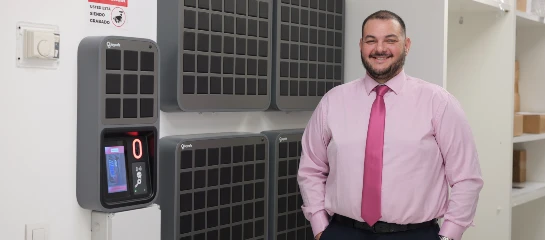
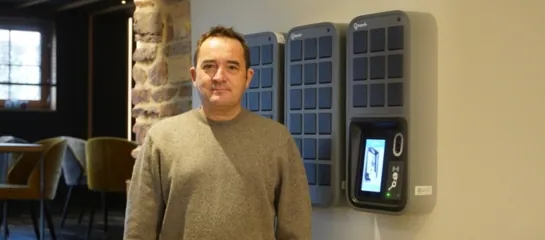
Capacity behaves the same way. A cabinet opens at nine key positions and grows by chained modules, so a portfolio that consolidates from thirty tourist flats to twelve longer lets and one building does not strand hardware. Bins are reassigned.
The physical and governance picture
Barcelona's Eixample and Ciutat Vella building stock puts most operators into the same conversation.
The comunidad de propietarios controls the shared entrance and stairwell, and Spanish law has given communities meaningful power to restrict tourist activity by qualified majority. In a city where the political direction is unambiguous, arriving at a junta with a request to install tourist infrastructure is a difficult sell.
There is a better argument available, and it is more honest than the usual one. What you are proposing is not tourist infrastructure. It is access infrastructure that will still be in the building when the flat is a long-term home, that removes anonymous codes and lockboxes from the entrance, and that gives the community a record of who came through the door. Framed against the 2028 horizon, you are asking for something that outlives the thing they object to.
Where the community will not agree, a ground-floor commercial space serving a cluster is the standard alternative, and it has the additional merit of being entirely under your control regardless of what any junta decides later.
Documentation while the clock runs
Enforcement intensifies rather than relaxes ahead of a phase-out, and Barcelona's compliance stack is layered: the HUT authorisation, the cèdula d'habitabilitat, the Catalan tourism registry number displayed on listings, and Spain's national single registry with annual renewal.
An access record does none of that. It records who entered and when. Its use in Barcelona over the next two seasons is mostly defensive: community complaints about occupancy or unfamiliar people, insurance and damage claims, disputes at the end of a longer let, and inspection contexts where you want to demonstrate a controlled operation rather than an improvised one.
At the point of key release, identity verification can be required, which binds the handover to a confirmed individual rather than a code that has been forwarded through a booking thread.
Buy the part that lasts
Barcelona has told its operators exactly when the current model ends, which is more warning than most industries get. The useful response is to separate the spend that only makes sense inside the window from the spend that carries across it.
Marketing to tourists, tourist-specific software, and anything priced per nightly booking belongs in the first category. Keys, doors, permissions and records belong in the second. Those exist in every version of what a Barcelona property does next.
Configure a SmartBox deployment or speak with our team about what carries through the transition.
Regulatory details in this article reflect publicly available information at the time of writing and are provided for general guidance only. Barcelona's licence phase-out, Catalan regional rules, and Spanish national registration requirements remain subject to political and legal change. Confirm current requirements with the Ajuntament de Barcelona, the Generalitat de Catalunya, and qualified Spanish advisers before making operational or investment decisions.