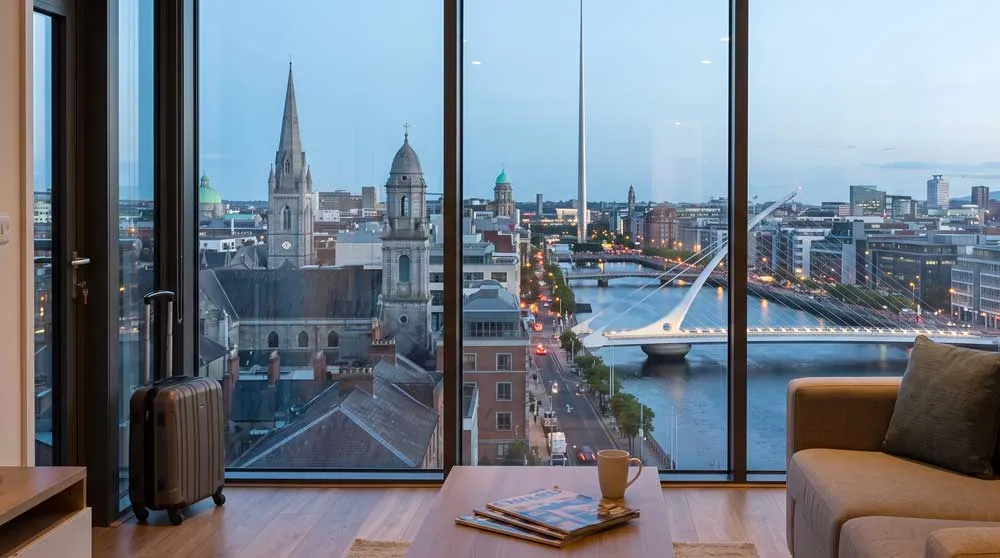

Ireland drew its line at 21 nights.
Under the Short Term Letting and Tourism Act 2025, short-term letting means stays of up to 21 nights. Anything longer sits outside the definition, outside the register, and outside the regime built around it.
That is the shortest threshold anywhere in this series. Los Angeles and New York use 30 days. Toronto and Melbourne use 28. Barcelona uses 31. Dublin's line sits at three weeks, which means a booking of 22 nights is simply not a short-term let in Irish law.
For most cities, the equivalent threshold is a technicality. In Dublin it is close to the whole strategic picture, because this is a city whose economy was already producing exactly the kind of stay that lands above the line.
What sits above 21 nights in Dublin
Dublin runs on multinational presence. European headquarters for large technology firms, a substantial pharmaceutical and medical device sector, financial services that expanded after Brexit, and the professional services layer that follows all of it.
That economy generates a specific and reliable housing demand: people arriving for one to six months. Relocating employees waiting on permanent accommodation in a famously tight market. Contractors on project work. Visiting engineers, auditors, consultants and clinical staff. Academic appointments across the universities and teaching hospitals.
None of that is tourism, and almost none of it falls under 21 nights.
The result is a professional accommodation market in Dublin that is weighted toward serviced apartments, corporate lets and mid-term furnished tenancies far more heavily than a tourist-first city would be. Operators who came out of the holiday letting world and moved up the duration curve have generally found the demand was already there waiting.
The regime below the line, and why it is tightening
For anyone still operating under 21 nights, Dublin is among the harder European cities to do it in legally.
Planning permission. Letting an entire principal private residence beyond 90 days a year, or letting any property that is not your principal private residence, will normally require change of use planning permission from Dublin City Council. Home sharing, where you let rooms while continuing to live in the property, is treated differently and is generally not restricted in the same way.
The register. A national short-term letting register administered by Fáilte Ireland is being introduced under the 2025 Act, covering stays of up to 21 nights, issuing a unique number per unit that must appear on every listing and advertisement, with annual renewal and a declaration that the property complies with planning requirements. Timing has moved during the legislative process, so treat Citizens Information and Fáilte Ireland as the authority on the current date rather than any secondary summary.
Platform enforcement. The register is designed for data-led enforcement. Listings without a valid number face suspension, and platform verification obligations align with the EU short-term rental regulation.
Rent regulation. The localised Rent Pressure Zone system was replaced by a national rent control framework from 1 March 2026. For short-term letting purposes the practical position is unchanged: Dublin remains a market where converting residential stock to tourism use is actively discouraged.
Historically, enforcement of the planning requirement was weak, and investigations repeatedly found that a majority of Dublin listings lacked the necessary permission. The register is the mechanism that changes that, because it moves the question from "will anyone check" to "does a number exist."
What longer stays do to key management
Moving above 21 nights solves a regulatory problem and creates an operational one, and operators are often surprised by the second.
A tourist let is an arrival problem. Someone lands, needs a key, needs it at an unpredictable hour, and then leaves a few days later. High frequency, short duration, one type of person.
A three-month corporate placement is an access management problem. There is one arrival, but across those three months you have a fortnightly or monthly cleaner, a maintenance callout or two, a gas safety or electrical inspection, possibly a letting agent bringing viewings toward the end, and in an apartment block, the management company's own contractors. All of them need access, at different times, with different scopes, repeatedly.
The systems built purely for guest check-in handle the first case well and the second badly, because they think in bookings.
The alternative is to hand out access to a person for a stretch of time. A relocating employee holds it for the length of their placement. The cleaner holds a repeating Tuesday morning. An electrician holds two hours on a Thursday in March. The property manager holds it permanently. Each is separate, each is logged, and any of them can be lifted the moment it should end.
The same arrangement covers a stay of four nights and a stay of four months without changing anything, which matters because most Dublin operators now run both.
Where the hardware goes in a Georgian city
Dublin's building stock creates a specific set of options.
Georgian conversions. Much of the inner city, particularly around the squares and the canal, is Georgian townhouses subdivided into flats with a shared hall behind the front door. That hall is common area, controlled by the management company or the other owners, and much of this stock is protected structure, which sharply limits what can be attached to a front elevation. Interior positions past the front door are the realistic route, and consent should be obtained in writing.
Purpose-built apartment blocks. The Docklands, Grand Canal Dock, and the newer developments across the city have lobbies, post rooms and management offices with power and connectivity already present. These are straightforward installations and often serve an entire building.
Suburban houses. Rathmines, Ranelagh, Clontarf and the outer suburbs are lower density with more separation. Operators here tend toward a single point at their own office rather than per-property hardware.
Cluster points. Dublin's core is compact and walkable, and the LUAS and DART cover a lot of ground. A single well-placed access point can reasonably serve properties across the city centre, which keeps guest instructions to one address.
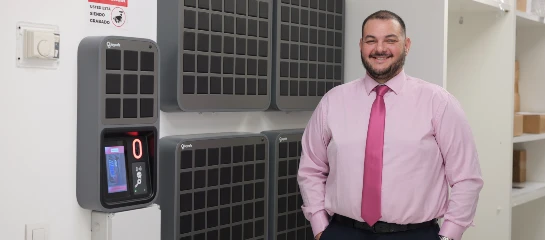
Capacity begins at 9 key positions and extends through chained modules, so a serviced apartment operator can start with a building's worth of keys and grow into a portfolio's worth on the same installation.
Documentation, honestly framed
Access records do not register your property with Fáilte Ireland, obtain your planning permission, or count your nights. Registration and planning are paperwork exercises and should be treated as such.
What the record does is establish who physically entered a property and when. In Dublin that gets used for deposit and dilapidations disputes at the end of a corporate tenancy, insurance claims, management company queries about unfamiliar people in a block, contractor damage attribution, and any situation where a landlord, an employer's relocation team or an insurer wants a factual account rather than a recollection.
For operators running corporate accounts, there is a commercial angle too. Relocation managers and HR teams placing employees are buying reassurance as much as accommodation, and an operator who can demonstrate controlled, logged, individually permissioned access is selling something a lockbox operator cannot.
The line is where the business is
Ireland set its threshold lower than anywhere else in Europe, and Dublin's economy happens to produce a great deal of demand that sits comfortably above it. That is an unusually favourable accident for operators willing to run a mid-term book rather than a nightly one.
What changes is the access pattern. Fewer arrivals, more vendors, longer permissions, and a client base that expects to see the controls you have in place.
Configure a SmartBox deployment or speak with our team about a Dublin installation.
Regulatory details in this article reflect publicly available information at the time of writing and are provided for general guidance only. Irish short-term letting legislation, register commencement dates, planning requirements and rent regulation have all changed recently and continue to evolve. Confirm current requirements with Citizens Information, Fáilte Ireland, Dublin City Council, and qualified Irish advisers before making operational decisions.