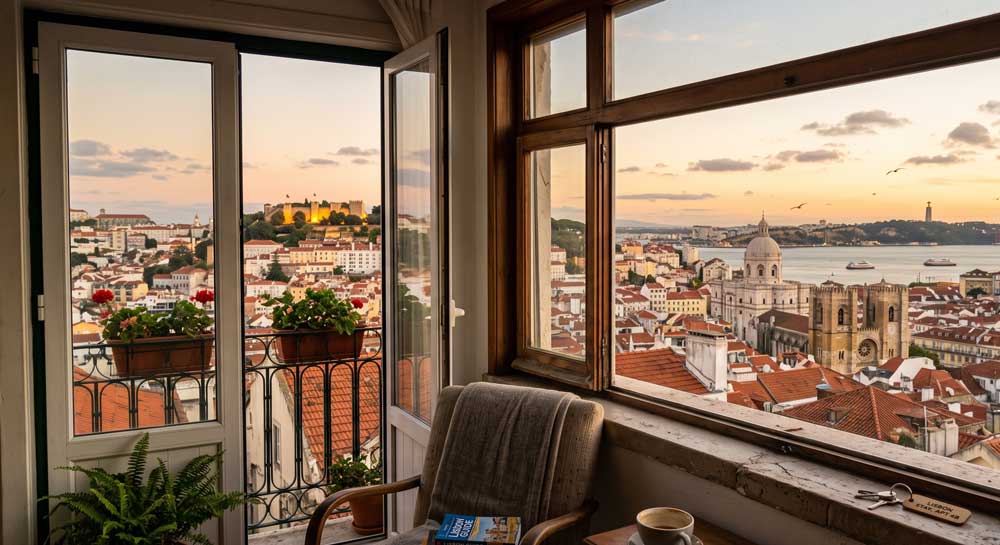

Try driving to a property in Alfama.
You will get as far as a street that turns into steps, or a lane the width of a wheelbarrow, or a corner a van physically cannot turn. Then you park somewhere legal, which is a separate adventure, and walk the rest uphill carrying whatever you were delivering.
Now do that at eleven at night because a guest cannot get in, and again at seven the next morning because the cleaner needs a key, and understand why Lisbon operators talk about their portfolios in terms of steps rather than kilometres.
This is a city built across seven hills with a historic core of medieval street plans that predate wheeled delivery by several centuries. And through an accident of regulation, that is exactly where the licensed rental stock is concentrated and where it is going to stay.
Why the awkward neighbourhoods are the permanent ones
Portugal's regulatory picture reset twice in quick succession, and the outcome matters for how you plan.
The Mais Habitação package had imposed a national suspension on new alojamento local registrations, five-yearly reauthorisation, and an extraordinary levy. Decreto-Lei 76/2024, in force from November 2024, reversed most of that. The national suspension ended, registrations returned to indefinite duration, the extraordinary contribution was repealed, and transfers were permitted again outside municipal containment areas.
Power went back to the municipalities, and Lisbon used it. The second amendment to the city's alojamento local regulation was published in December 2025 and applies from 2026, cutting the thresholds that trigger containment. Neighbourhoods reaching a ratio of around 10% alojamento local against permanent housing fall into absolute containment, with new registrations suspended; relative containment activates at around 5%. The amendment also tightened scrutiny of inactive licences and limited transferability inside containment areas.
The practical consequence is straightforward. Existing registrations generally continue. New ones are blocked or heavily restricted across large parts of the city, and the parts most affected are the historic centre neighbourhoods where the ratios are highest.
So the Lisbon portfolio you hold is broadly the Lisbon portfolio you will keep. You are not going to add units in Alfama, Mouraria or Bairro Alto. You are going to operate the ones you have, for a long time, in the least vehicle-accessible terrain of any city in this series. That is an argument for investing in how those specific properties are run rather than waiting for the portfolio to change shape.
Terrain as an operating cost
Every manual key handover in central Lisbon carries a terrain tax that does not exist in a flat city.
You cannot drive to the door. In Alfama, Mouraria, Graça, Castelo and much of Bairro Alto, the last stretch is on foot and uphill. A handover that would take fifteen minutes in a flat grid takes forty.
Parking is its own problem. Finding a legal space near the historic core, at the times guests actually arrive, is not reliable.
The 28 tram is a tourist attraction, not logistics. Neither is the Elevador da Bica. Public transport in the old city moves people slowly and on its own schedule.
Staff fatigue is real. A cleaner working a hillside cluster is climbing all day. Adding key runs to that is how you lose good cleaners in a tight labour market.
Guests arrive tired and uphill. Someone dragging a suitcase up from Baixa in July does not want a further diversion to collect a key from somewhere that is not the property.
Add it up across a portfolio and terrain is usually the single largest hidden operating cost in a Lisbon operation. It also does not improve with scale. Twenty properties across three hills is not twice as efficient as ten.
Where the key should live
The design principle for Lisbon is simple: the guest should climb once.
Whatever route someone takes from the airport, the Metro or Santa Apolónia, they should arrive at or immediately beside the property, and the key should already be there. Any arrangement that sends them somewhere else first, then back, doubles the worst part of their journey.
That points toward a placement pattern quite different from the cluster-point logic that works in flat, dense cities.
At the building, wherever possible. Inside the entrance hall behind the street door, in a stairwell landing, or in a light well. This is the ideal in the hillside neighbourhoods precisely because the walk between two nearby addresses can involve fifty steps.
One point per hill, not one per district. Where a per-building install is not possible, group properties by the climb rather than by the map. Two addresses two hundred metres apart on opposite sides of a hill are not near each other in any operationally meaningful sense.
Take the flatter ground when you have it. For properties in Baixa, Chiado, Príncipe Real, Avenidas Novas or Parque das Nações, standard cluster logic applies and a single point can cover a good deal of territory.
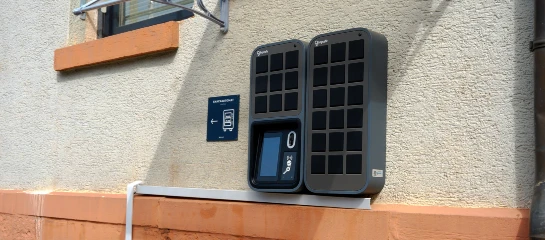
On the building itself, Lisbon's constraints echo other historic European cities. Frontages in protected areas restrict what can be attached externally, and the condomínio controls the shared entrance. Interior positions past the street door are the usual answer, and the hardware fixes flat to a wall, projecting about four inches, with an IP52 rating that suits sheltered positions. The azulejo-clad façades of the old city are not somewhere to be drilling.
Access built for the people who climb
The operational win in Lisbon is less about guests than about staff.
Cleaning teams working hillside clusters benefit most from never having to detour for a key. Each cleaner holds their own credential on their own schedule, so a route can be walked once, in order, without a return trip to collect or drop off. Maintenance and the building's own contractors get their own windows.
Access is issued to a named person for a defined stretch of time rather than tied to a booking, which means a three-night guest, a monthly cleaning contract and a one-off electrician all sit on the same key without interfering. Anything can be withdrawn immediately.
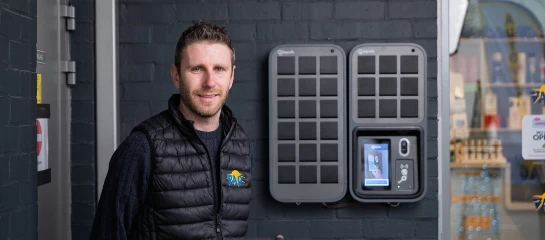
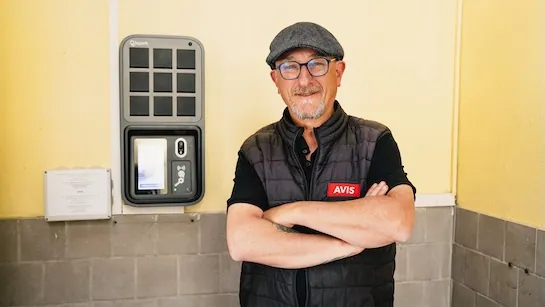
Capacity opens at nine key positions and extends through chained modules, which for a hillside portfolio usually means several modest installations rather than one large one. That is the correct shape here even though it is the opposite of what a flat city would do.
On the software side, the main booking and management platforms connect directly with an API behind them, so credentials go out when a stay is confirmed, in the guest's language, with directions written for someone on foot rather than someone driving.
Guest reporting and the record
Portugal requires foreign guests to be reported through SIBA, with penalties per unreported guest running from around €100 to €2,000, and the alojamento local registration number governs whether you can advertise.
An access system does not submit your SIBA declarations or hold your AL registration. What it adds is verification at the point of entry, tying a key release to a confirmed individual rather than a code that may have circulated, and a record of the handover that names the person and the time and exports on request.
In Lisbon that record earns its keep in condomínio disputes about who has been coming and going, damage and deposit arguments, insurance claims, and the increasingly common situation where a neighbour or the câmara asks questions about how a property is being operated.
Design for the climb
Lisbon's regulation has effectively frozen the shape of most operators' portfolios, and that shape is concentrated in the parts of the city that are hardest to reach. Nothing about that is going to change, so the sensible response is to stop treating terrain as an occasional inconvenience and start treating it as the defining constraint it is.
Put the key at the top of the hill, next to the door it opens, and the climb happens once.
Configure a SmartBox deployment or speak with our team about siting access points across a Lisbon portfolio.
Regulatory details in this article reflect publicly available information at the time of writing and are provided for general guidance only. Portuguese national legislation and Câmara Municipal de Lisboa containment rules have changed repeatedly and containment classifications are updated periodically. Confirm current requirements with the Câmara Municipal de Lisboa, Turismo de Portugal, and qualified Portuguese advisers before making operational decisions.