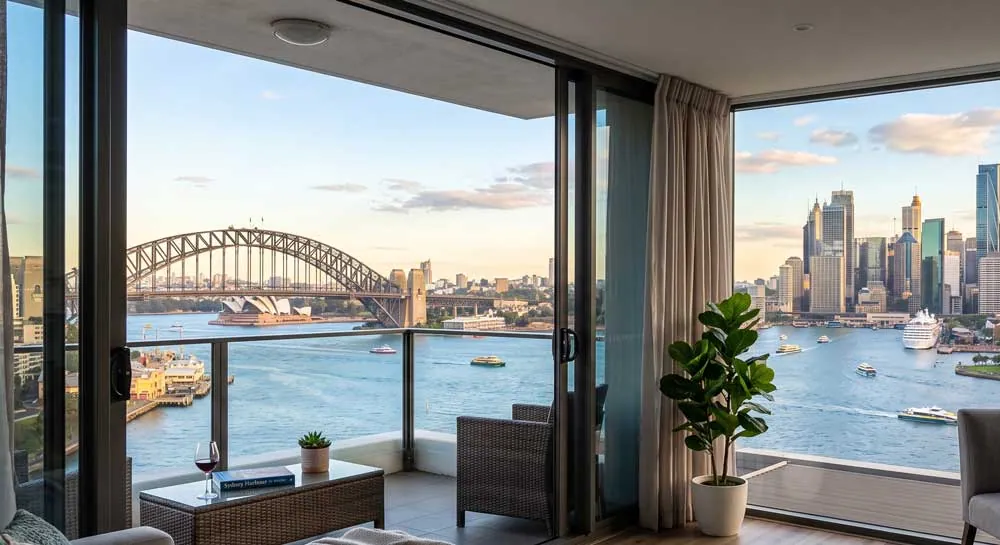

New South Wales did something no other jurisdiction in this series has done. It built a mechanism for banning people from the industry.
The STRA Exclusion Register is a public list maintained under the state's mandatory Code of Conduct. Serious or repeated breaches can put a host, a letting agent or a management company on it, and the effect is a five-year exclusion from participating in short-term rental accommodation in NSW. The framework operates on a two-strikes approach for serious contraventions within a two-year window, and penalties for serious breaches have been set at levels reaching into the hundreds of thousands of dollars for individuals and beyond a million for corporations.
Guests can be listed too. A guest who causes damage or a serious disturbance can end up on the register, and platforms are then required to refuse their bookings.
That last detail changes the nature of the job. In most cities, knowing exactly who entered your property is useful. In Sydney it is the foundation of the only defence you have.
The Code makes you responsible for behaviour
The NSW Code of Conduct binds hosts, guests, letting agents and booking platforms alike. Among the host obligations: maintain a 24/7 contact number for guests and neighbours, manage noise, waste and antisocial behaviour, respond promptly to complaints, and hold adequate third-party liability insurance.
Read that as an operational specification rather than a legal formality. You are being asked to answer for conduct at a property you are not standing in, by people you have never met, at times you are not awake.
The complaint arrives days later. A neighbour says there was a party on the Saturday. The strata committee says twelve people came through the lobby. Someone says the guest let a group in through the fire stair. You have a booking for four.
At that point you need to establish facts, and the questions are all about access. How many separate people collected a key? At what times? Was a key returned? Did anyone hold access who should not have? Was there a handover you did not authorise?
A booking record cannot answer any of that. It tells you who paid. An access record tells you who came.
What Sydney's rules require of the operation
Beyond the Code, the planning framework sets the boundaries.
Registration. Every STRA property must appear on the NSW STRA Register and display its STRA Property ID on listings. The register tracks day limits and supports fire safety compliance.
The 180-day cap. Non-hosted STRA in the Greater Sydney region is limited to 180 days in each 12-month registration period. Hosted STRA, where the host lives on the premises during the stay, has no equivalent cap. Bookings of 21 consecutive days or more are exempt from counting toward the limit, which is a detail worth building into your calendar strategy rather than discovering in November.
Strata by-laws. An owners corporation can prohibit non-hosted STRA in a lot that is not the owner's principal place of residence, by special resolution under section 137A of the Strata Schemes Management Act 2015. It cannot restrict hosted STRA where the owner lives on site. Development consent conditions may add further restrictions.
Fire safety. Dwellings used for STRA must meet specified standards, including interconnected smoke alarms and evacuation diagrams, with penalty notice offences attached.
Duration. NSW treats stays of up to three months as STRA. Beyond that you are generally into residential tenancy territory under the Residential Tenancies Act 2010, with an entirely different set of obligations.
Geography: two cities in one
Sydney's portfolios tend to split along a line that most operators recognise immediately.
The harbour and the east. The CBD, Potts Point, Surry Hills, Darlinghurst, Pyrmont and the inner east are apartment territory. Strata buildings, secure lobbies, lifts, sometimes a building manager. Density is high enough that one access point can serve a cluster of buildings within a walk.
The beaches and the north. Bondi, Coogee, Manly, and up through the northern beaches. Lower density, more houses and small blocks, more separation between properties, and public transport that thins out quickly. Manly in particular is functionally an island for operational purposes: the ferry is lovely and it is not a way to move a key at short notice.
The inner west and beyond. Newtown, Marrickville, Balmain and out toward Parramatta. Terraces and small unit blocks, and distances that start to matter.
The practical consequence is that most Sydney operators of any scale end up with two or three access points rather than one, and the split usually falls along that harbour and coast divide rather than by suburb count.
Building the record
An access system in Sydney should be judged on what it can prove, not just what it can open.
When someone collects a key, the system records who they are, which key they took, and the moment they took it. Return the same way. Nothing leaves anonymously, because there is no shared code to pass around. Where you want a higher standard, identity verification can sit in front of the release, tying the handover to a confirmed person rather than a phone that received a message.
This produces three things that matter under the NSW framework.
A count. How many individuals actually collected access for a given stay. If your booking was for four and six people took keys, you know before the strata committee tells you.
A timeline. Arrival and departure times, and any access outside the booked window. Useful when the complaint is about a specific Saturday night.
A named list. Cleaners, maintenance contractors, agents and guests, each with their own credential and their own window. When the question is whether an unauthorised person entered, you have an answer rather than an inference.
None of this proves you complied with the Code. Conduct obligations are broader than access. But when a complaint escalates and NSW Fair Trading is asking what happened, the operator who can produce a precise, timestamped, exportable record is in a materially different position from the one reconstructing a weekend from memory and a group chat.
Working with the owners corporation
Given that a Sydney owners corporation can pass a by-law prohibiting non-hosted STRA in your lot, the relationship is worth actively managing rather than avoiding.
The complaints that lead to those by-laws are consistent: unknown people in the lobby, keys left with the concierge or hidden near the entrance, lockboxes appearing on fire hose reels and gates, guests wandering the building, nobody knowing who is meant to be there.
An access system addresses each of those directly, and it is worth saying so in writing. Committees respond to specifics: where the unit goes, how it fixes to the wall, its dimensions, how it draws power and connects, who maintains it, and what happens if it is ever removed. Offering the building manager visibility of the access log turns the proposal from a request into a contribution.
Where the committee will not move, operators generally site the hardware at their own premises instead, which in the denser inner suburbs still leaves guests a short walk.
The practical build
A base cabinet carries 9 keys. Additional modules chain onto it as the portfolio grows, so an access point can go from a single cluster to several hundred keys without a second installation or a second address in your guest instructions.
Access is granted to a named individual for a defined stretch of time, which is the structure the Code implicitly assumes. A guest holds it for the booking. A cleaner holds a standing Monday and Thursday slot. A plumber gets Wednesday between ten and twelve. Anything can be withdrawn immediately, which matters when you need to demonstrate that you acted on a complaint.
On the software side, the major booking and management platforms connect directly, with an API for whatever else you run, so credentials are issued the moment a stay is confirmed rather than by someone remembering to send a message.
For hardware placement, the unit is rated IP52 and suits sheltered positions. Sydney's coastal suburbs add a consideration the inland cities do not have: salt air is hard on everything mounted outdoors near the water, so at Bondi, Coogee or Manly, an interior or well-sheltered location is worth the extra planning.
Know who came through the door
Sydney's regulatory design puts conduct at the centre and attaches real consequences to it, up to and including removal from the industry for five years. That is an unusually sharp incentive to run an operation where you can always answer the question of who entered a property and when.
Automated key control is the cheapest way to make that question answerable, and the answer is the same one whether it is a neighbour, a strata committee or Fair Trading doing the asking.
Configure a SmartBox deployment or talk to our team about a Sydney setup.
Regulatory details in this article reflect publicly available information at the time of writing and are provided for general guidance only. NSW planning rules, the STRA Code of Conduct, strata legislation, and day limits change over time. Confirm current requirements with NSW Fair Trading, the NSW Department of Planning, your owners corporation, and qualified Australian advisers before making operational decisions.