
Toronto's key handover has a temperature.
For four or five months of the year, everything about moving a physical key across this city gets harder. Lockbox dials seize with ice. Road salt corrodes the cheap ones until the shackle will not release. A guest standing outside a CityPlace tower at eleven at night in February, fumbling with frozen fingers at a combination they have read off a phone screen with the brightness turned down, is not having a minor inconvenience. In an ice storm, with a suitcase, that is a safety problem.
Every other city in this series has a key problem shaped by law, geography or building stock. Toronto has all of those too. But it also has a key problem shaped by January, and no amount of clever scheduling makes minus twenty degrees more convenient.
The 28-day line
Before the operational picture, the market context, because Toronto's regulatory threshold sits in an unusual place and it has moved a lot of business.
The City of Toronto defines a short-term rental as a stay of fewer than 28 consecutive days. Below that line, you need to register with the city, display the registration number on every listing, operate only from your principal residence, cap entire-unit rentals at 180 nights a year, and collect the Municipal Accommodation Tax. The city launched an API in late 2025 that platforms must use to verify registration numbers, and penalties for non-compliance run from hundreds of dollars into six figures for serious cases. MAT was temporarily raised from 6% to 8.5% for the period running to 31 July 2026.
Above the line, at 28 days or more, essentially all of that falls away. No registration requirement, no 180-night cap, no principal residence condition, and MAT does not apply.
Most cities draw this line at 30 days. Toronto drawing it at 28 puts it neatly at four weeks, which happens to align with how corporate housing, insurance placements, travelling medical staff and production crews already think about bookings. The result is that a large share of Toronto's professional furnished-rental business now sits above the line, in condo towers, on monthly terms.
That shift changes what the key system has to do. A monthly tenancy produces one arrival where a nightly listing produced thirty. What it does not reduce is everyone else: the cleaners on a monthly cycle, the trades, the inspectors, the leasing agents working the unit ahead of the next placement, and the building's own staff.
Winter is the operational constraint
Toronto's furnished rental stock is concentrated vertically, in the towers of CityPlace, Liberty Village, the Entertainment District, Yonge and Eglinton, and along the waterfront. That concentration is helpful. It means one installation can serve a lot of doors.
It is also what makes winter tractable, because the alternative is worse than people remember.
Outdoor lockboxes fail in the cold. Mechanical dials stiffen and jam. Moisture gets in, freezes, and the mechanism will not turn. Road salt spray accelerates corrosion on anything mounted near a driveway or sidewalk. The failure mode is not gradual; it is a guest outside at night who cannot get in.
Manual handovers get expensive and unreliable. A staff member driving from Leslieville to Etobicoke to let someone in during a snow event is a bad use of an hour and a genuine risk. Toronto winter driving conditions turn a 25-minute trip into an hour and a half with no warning.
The PATH does not help you. Downtown Toronto's underground network is excellent for people already inside it and irrelevant to someone arriving from Pearson with luggage.
Guests do not linger outdoors. Any arrival process that involves standing still outside for more than a few seconds in February produces support calls, poor reviews, and occasionally a genuinely unsafe situation.
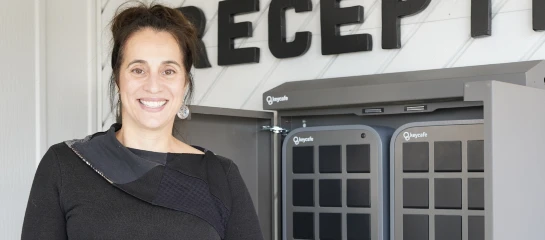
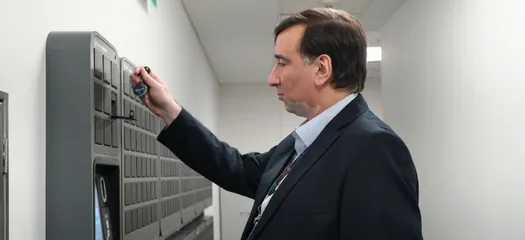
The answer is an indoor installation. A SmartBox mounted in a tower lobby, mail room, parcel room or management office is inside the heated envelope, and the guest's entire interaction with the key happens indoors. The unit itself is rated IP52 and carries battery backup, and cellular connectivity is available where a concrete tower or an underground parking level defeats WiFi. But the more important point is simply that the interaction is inside.
One tower, several operators
Toronto has a structural feature that most cities do not. Because so much of the furnished rental stock is small investor-owned condo units concentrated in a handful of very large buildings, it is common for several unrelated operators to hold units in the same tower.
That creates an option worth raising with a condo board: a single installation in the building serving multiple operators, with each operator seeing only their own keys.
From the board's perspective this is attractive in a way that a single operator's request is not. Instead of approving one alteration, then another, then fielding complaints about lockboxes appearing on the bike racks in the parking garage, the board gets one controlled system that replaces the informal arrangements it already dislikes. Under Ontario's Condominium Act, boards hold real authority to restrict short-term rentals regardless of what the city permits, so arriving with a proposal that serves the building rather than just your units changes the conversation.
The concierge desk is the specific pain point to name. Most Toronto towers have one, most hold keys informally for residents and their contractors, almost none have a written policy or a log, and the corporation carries the liability. A controlled cabinet keeps keys available across every shift and takes that exposure off the desk.
Access built for a monthly portfolio
Keycafe assigns access per person and per time window rather than per booking, which is the right structure for a market that has moved to 28-day-plus terms.
A tenant on a three-month placement holds access for three months. The cleaner holds a recurring biweekly window. The HVAC contractor gets a two-hour slot on Wednesday. A leasing agent gets Saturday afternoon during the changeover month. Building staff hold standing access to operational keys. Each permission is separate, separately logged, and revocable in real time.
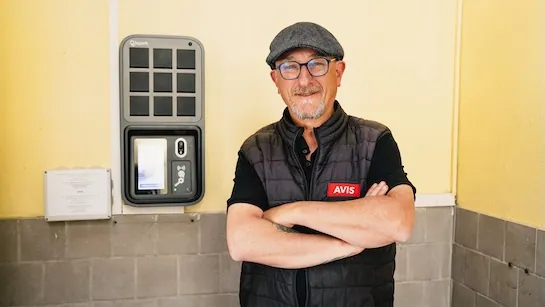
For operators running units both above and below the 28-day line, nothing about the infrastructure differs between them. A base unit holds 9 keys and takes daisy-chained expansion modules on top of that, which in a tower context means one installation can carry a key for every unit you manage plus the building's own operational set.
On the software side, the platforms most Toronto operators already run are supported directly, Airbnb, Guesty, Hostaway and Res:harmonics among them, with an API for anything outside that list. Tenants and vendors get a code, a QR or a wallet pass.
Records, and what they are good for
Access logs do not track your nights against the 180 cap, and they do not file your MAT return. The city expects you to keep booking records, and you should, particularly given that quarterly MAT filing is required even in a zero-booking quarter and the city audits.
What the log does is answer questions about physical entry. Toronto generates plenty of them: damage attribution after a monthly tenancy, insurance claims following a water escape in a tower, board queries about unfamiliar people in the building, contractor disputes, and the recurring question of who let someone into the parking garage. A named, timestamped, exportable record ends those conversations quickly.
Take the winter out of the handover
Toronto has spent the last few years reorganising itself around the 28-day line, and the practical result is a furnished rental market concentrated in condo towers on monthly terms, with heavy vendor traffic and a five-month stretch when nothing about moving a physical key outdoors is pleasant or reliable.
The fix is not a better lockbox. It is moving the handover indoors, into a system that works the same in January as it does in July, and does not depend on anyone driving anywhere in a snow event.
Configure a SmartBox deployment or talk to our team about an installation in your building.
Regulatory details in this article reflect publicly available information at the time of writing and are provided for general guidance only. City of Toronto short-term rental rules, tax rates, and condominium law change over time. Confirm current requirements with the City of Toronto, your condominium corporation, and qualified Ontario advisers before making operational decisions.