
Most cities have a check-in problem. Los Angeles has a driving problem.
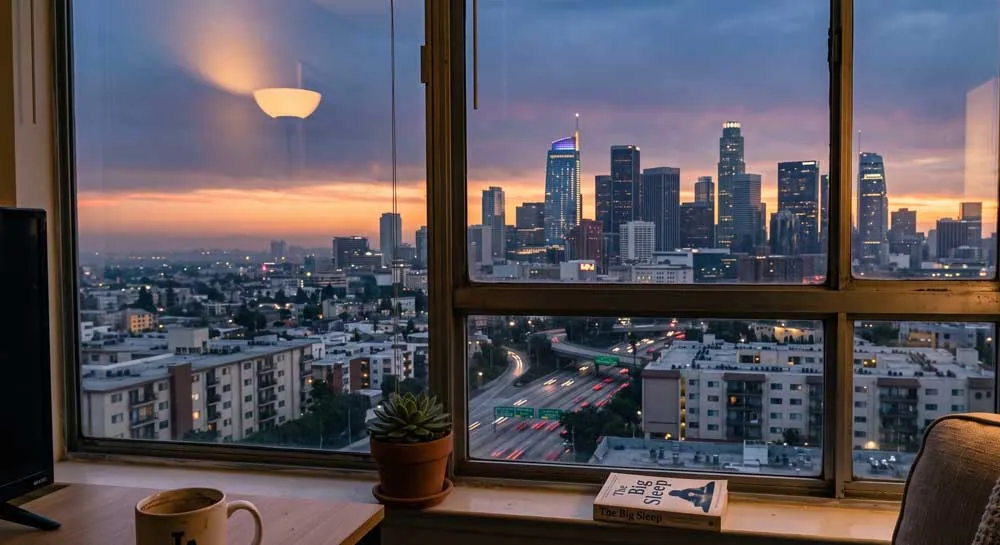
If you operate short-term or furnished rentals here, your portfolio is almost certainly not in one neighborhood. It's a few units in Venice or Mar Vista, something in Hollywood or Los Feliz, a couple of downtown lofts, maybe a house in the Valley or out toward Pasadena. The City of Los Angeles alone covers close to 500 square miles, and the county wraps 88 separate cities around it. A fifteen-mile hop from Santa Monica to Silver Lake is a twenty-minute drive at 6 a.m. and an hour and fifteen at 5 p.m.
That geography is what quietly sets the ceiling on an LA rental operation. Not demand, not pricing, not your listing photos. The number of times per week somebody on your team has to get in a car because a key ended up in the wrong place.
The real math on a key run in Los Angeles
Every operator has a version of this week. A guest lands at LAX three hours late and the lockbox code they were sent doesn't work. A cleaner finishes a Hollywood turnover and needs the key for the next unit, which is currently in a jacket pocket in Culver City. A plumber can get to the Highland Park duplex at 2 p.m., but the only key is at your office.
None of these are disasters. Each one is a drive.
Say your team absorbs three unplanned key runs a week and each one burns 90 minutes door-to-door with LA traffic factored in. That's roughly 230 hours a year, about six full working weeks, spent getting a piece of metal from one part of the county to another. At a loaded operations cost of $30 an hour, you're looking at close to $7,000 annually before fuel, mileage, or the parking ticket somebody inevitably picks up in Venice. And that figure ignores the more expensive part: the bookings you can't accept because your check-in still depends on a human being available.
For a long stretch, the workaround in LA was the public key-exchange network. Keycafe helped build that model, including SmartBoxes at partner businesses around Hollywood. It solved the 24/7 problem, and for a single host with one apartment it still can.
But it never solved the LA problem, because a public pickup point only helps guests who are near it. Sending a Venice arrival to Hollywood for a key is a 40-minute detour on a good day. In a city this spread out, you don't need one place where keys live. You need keys living near the properties they open.
Put the box where your portfolio actually is
The shift for professional LA operators is straightforward: stop borrowing someone else's location and own the hardware.
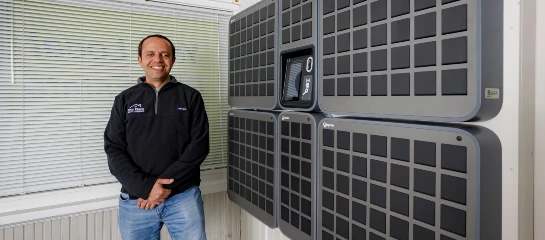
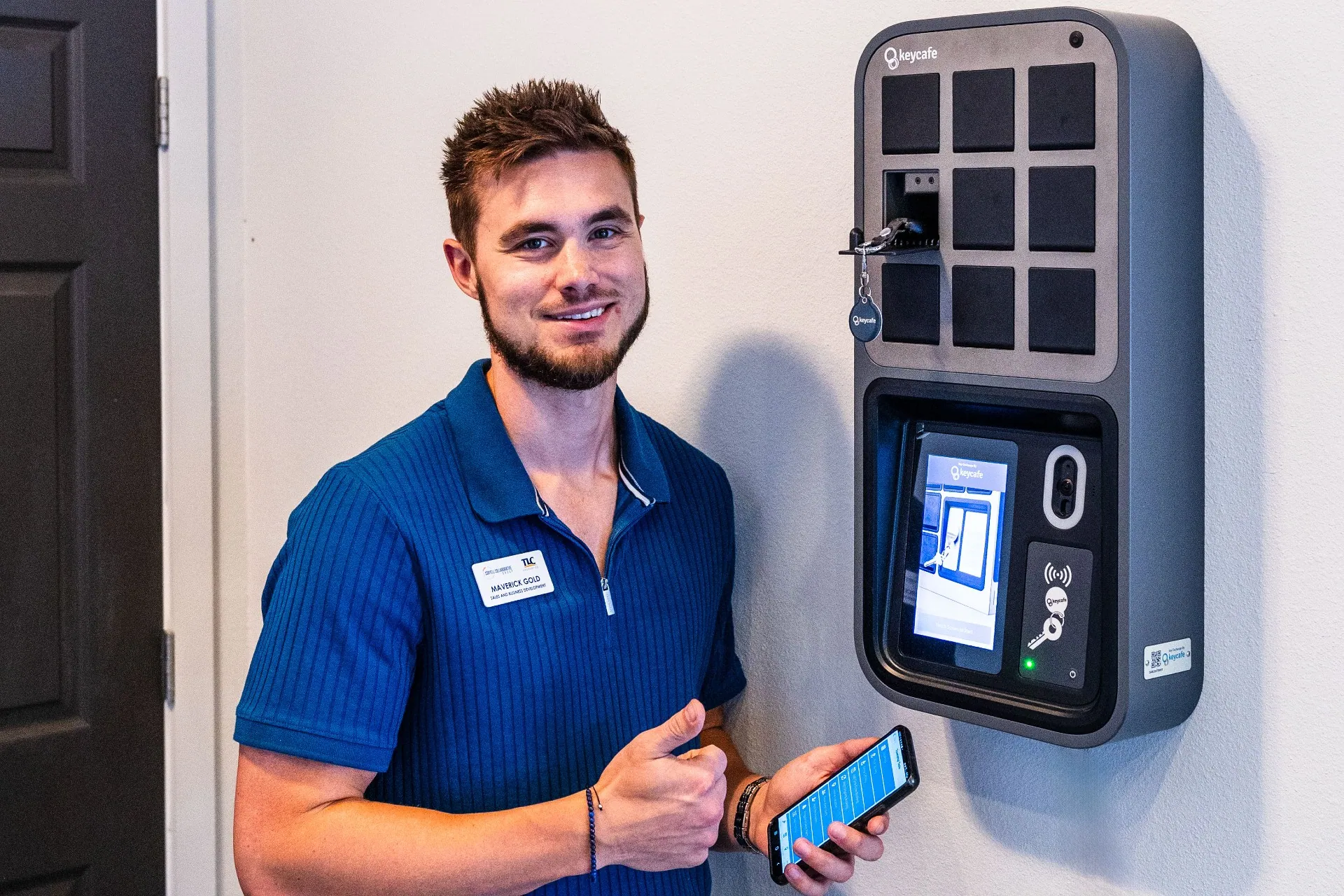
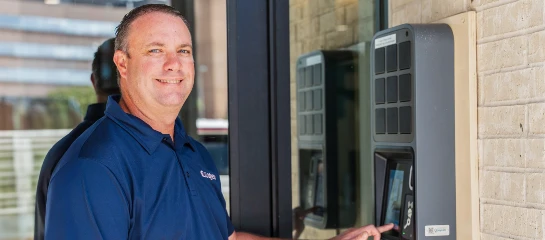
A Keycafe SmartBox mounts on any wall. An office, a building lobby, a parking structure, a garage, or the exterior of a unit you already control. It's roughly the footprint of a picture frame at 11.4 inches wide and 4 inches deep, weather-resistant, and cloud-connected. Once it's installed, it's your key infrastructure, on your property, on your terms.
In LA that unlocks a deployment pattern that doesn't make sense in denser cities: hub-and-spoke by cluster. Rather than one central location, you place a SmartBox at each geographic concentration in your portfolio and let each one serve the units within a short radius.
A 40-unit operator might run something like:
Westside hub: Venice, Marina del Rey, Mar Vista, Palms
Central hub: Hollywood, Los Feliz, Silver Lake, Echo Park
Downtown hub: DTLA, Arts District, Koreatown
Valley hub: Studio City, Sherman Oaks, NoHo
Four boxes, four short trips instead of four cross-town expeditions. Guests are directed to a pickup point within a few minutes of their unit. Cleaners work a cluster and never leave it. Contractors collect what they need on the way to the job.
The hardware scales the way portfolios actually grow. A base unit starts at 9 key bins, and expansion modules daisy-chain onto it as a cluster fills up, so a single hub can grow into the hundreds of keys without changing anything about how your team works. You add capacity to the hub that's tight rather than re-architecting the whole system, which matters in a market where you might pick up six units in Koreatown and none anywhere else.
Access that matches how LA operators actually staff
The people touching your keys in Los Angeles are rarely on your payroll. Cleaning crews run their own routes across multiple clients. Handymen, pool techs, pest control, and landscapers all work on independent schedules. Co-hosts cover for each other. The lockbox code you shared in 2023 has been forwarded to people you've never met.
Keycafe replaces shared codes with individual, time-bound permissions:
A guest gets access from check-in to check-out, and it expires on its own.
A cleaner gets a recurring window every Tuesday and Friday morning, nothing more.
A contractor gets a single two-hour slot on Thursday afternoon.
A departing employee loses access the moment you revoke it, with no rekeying and no wondering who still has a copy.
Every pickup and return is timestamped and attached to a named person. When something goes wrong, and in a portfolio this dispersed something eventually does, you're reading a log instead of reconstructing a week from group chats.
Documentation is now part of the job in LA
Los Angeles asks more of operators on paper than most US markets, and enforcement has moved from complaint-driven to automated. Under the city's Home-Sharing Ordinance, hosts register with City Planning, display a registration number on every listing, and are limited to unhosted stays in a primary residence, with a 120-day annual cap unless they qualify for Extended Home-Sharing. Transient occupancy tax runs 14% on stays of 30 days or less, and penalties for operating outside the rules reach into the thousands of dollars per day. Platform-level reporting means the city now cross-references booking data against its own registry rather than waiting for a neighbor to call.
Then there's the patchwork. The City of Los Angeles ordinance stops at the city line. West Hollywood, Santa Monica, Culver City, Beverly Hills, Pasadena, Burbank, Long Beach, and unincorporated county areas each run their own regime, and a portfolio that looks geographically tidy on a map can span four regulatory frameworks. Rules also change frequently, so treat the city's own published requirements as the source of truth before making operational decisions.
To be clear about what key control does and doesn't do here: a Keycafe log is not a substitute for registration, night-count tracking, or tax filing. What it gives you is a defensible, exportable record of physical access. Who entered which property, when, and under whose authorization. That record does real work in nuisance complaints, insurance claims, security deposit disputes, damage attribution, and any conversation where "we don't know who was in the unit" is an unacceptable answer. In a city with a 24/7 complaint line and a public records portal, being able to produce that record quickly is worth something.
The blended STR and mid-term reality
Something structural shifted in LA after January 2025. The Palisades and Eaton fires displaced thousands of households, and insurance-placement and relocation demand pulled a large share of the furnished-rental market toward stays of 30 days and longer. Layer on the entertainment industry's project-based housing, traveling medical staff around the major hospital systems, and a 120-day cap that pushes operators to look past nightly bookings, and a lot of LA portfolios now run a blend: short-term in peak season, mid-term the rest of the year.
The two models have genuinely different access profiles. Short-term is high-frequency guest turnover. Mid-term is low guest turnover but sustained vendor traffic: monthly cleans, maintenance visits, inspections, and agents showing the unit before the next placement. Systems built purely around guest check-in tend to handle the second case badly.
Because Keycafe assigns permissions per person and per window rather than per booking, the same SmartBox serves both. A unit running a 90-day insurance placement uses the same hardware, the same dashboard, and the same audit trail as the one turning over every three nights. When you flip a property between models, and LA operators flip constantly, nothing about your access infrastructure has to change.
What deployment looks like
Keycafe connects to the tools LA operators already run. Native integrations with Airbnb, Guesty, Hostaway, and Res:harmonics generate and send access codes automatically the moment a booking confirms, so nobody is copy-pasting codes into guest messages at 11 p.m. For anything custom, there's a full API.
Guests retrieve keys through the touchscreen, a QR code, PIN, NFC, or a wallet pass, with multilingual instructions. The MS5 carries battery backup and offline functionality. That is not a theoretical benefit in a city with rolling outages and Public Safety Power Shutoffs during fire weather, because key pickup keeps working when the power doesn't.
Most commercial accounts are running within days. Onboarding covers installation planning, integration, and team training.
Running an LA portfolio without the drive
The operators pulling ahead in Los Angeles aren't the ones with the best lockbox discipline. They're the ones who stopped treating physical keys as something a person has to move around a 500-square-mile city.
Owning your key infrastructure changes the shape of the business. Check-in stops depending on staff availability. Late arrivals stop being incidents. Your team's day stops being organized around the 405. And every access event becomes a record you can pull up in seconds instead of a story you have to piece together.
Build your SmartBox deployment or book a demo to map what this looks like across your LA clusters.
Regulatory details in this article reflect publicly available information at the time of writing and are provided for general guidance only. Short-term rental rules in Los Angeles and surrounding jurisdictions change frequently, so confirm current requirements with the relevant city before making operational decisions.