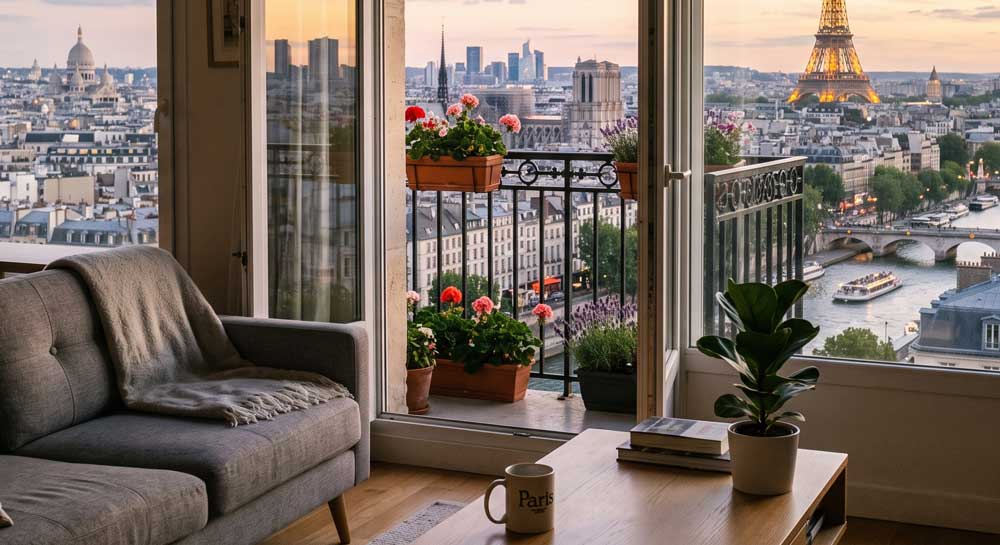

Here is a number worth sitting with. Paris intra-muros packs roughly 2.1 million people into about 105 square kilometres. It is one of the densest large cities on earth, and almost all of it is reachable on foot or with one Métro connection.
For anyone managing property here, that changes an equation that operators in most cities never get to solve. Everywhere else, the question is how many key points you need to cover a portfolio. In Paris, the question is how few.
An operator with thirty flats scattered across the 3e, 4e and 11e is not managing a dispersed portfolio. They are managing a fifteen-minute walk. One well-sited access point can realistically serve every one of those flats, and no other market in this series can make that claim.
The arrondissement is the natural service area
Paris is organised as a spiral of twenty arrondissements, and the inner ones are small. The 4e covers about 1.6 square kilometres. The 3e is smaller still. You can cross either in under twenty minutes at a stroll, and most visitors will happily do it, because walking through the Marais is not a chore in the way that a cross-town drive is in a sprawling city.
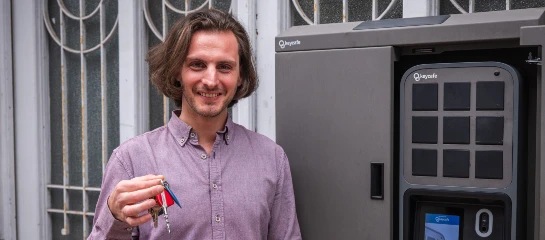
That means a single Keycafe SmartBox placed thoughtfully can act as the key point for an entire operating zone.
Le Marais and the Bastille corridor. The 3e, 4e and lower 11e function as one continuous walkable district. A point near République, Saint-Paul or Bastille reaches deep into all three.
Saint-Germain and the Latin Quarter. The 5e and 6e are tight, well-served by Odéon and Saint-Michel, and heavy with small tourist flats above ground-floor commerce.
Montmartre and South Pigalle. The 9e and 18e are the exception to the walking rule, because the hill is real. Plan for a point at the base rather than expecting guests to climb with luggage and then descend again.
The eastern arrondissements. The 10e, 11e, 19e and 20e have absorbed much of the growth in professional operation over the last decade. Distances are slightly larger and the Métro does more of the work.
La Défense and the inner suburbs. Corporate and longer-stay demand concentrates here, and the pattern shifts toward per-building installations because the buildings are larger and the flats are inside them.
The practical consequence is that Paris has the lowest hardware-to-door ratio of any market Keycafe operates in. Capacity is where the money goes, not coverage. A base unit starts at 9 key bins, and expansion modules daisy-chain onto it, so one Marais access point can grow from a handful of keys to several hundred without a second installation, a second lease, or a second set of guest instructions.
That last point is underrated. Guest instructions are a support cost. One address that every guest goes to, in three languages, with a fixed set of directions from three named Métro stops, is a fundamentally cheaper thing to operate than fourteen different arrival stories.
Where the box goes when the building says no
Paris buildings have their own opinions, and 2026 has given them teeth.
Under the loi Le Meur of 19 November 2024, copropriété regulations drawn up since that date must state explicitly whether tourist letting is permitted or prohibited, and existing regulations are expected to be updated to address it. A general assembly can vote to prohibit tourist letting of lots that are not principal residences, on a two-thirds majority, and the Conseil constitutionnel upheld that mechanism in March 2026.
Practically, this means the syndic conversation is now a live risk rather than a formality, and it is worth deciding early whether your access plan depends on the building at all.
Three routes, roughly in order of how often Paris operators take them:
A commercial ground-floor space. A small local, a storage unit, or a share of a partner business. This removes the copropriété question entirely, which in the current climate is worth paying for. It also tends to produce the best guest experience, because street-level access at any hour beats a code and a courtyard.
Inside the immeuble. The entrance hall past the porte cochère, or the courtyard. Requires the copropriété's agreement, and note that Haussmannian façades and courtyards in protected sectors carry heritage constraints on what can be fixed to a wall. Interior positions are far easier to get approved than anything visible from the street.
A shared point between operators. Several small operators in the same arrondissement splitting one installation. Uncommon, but the density makes it viable in a way it isn't elsewhere, and the software handles separate accounts on the same hardware without any of them seeing each other's keys.
What the 2026 rules actually require of you
Paris has been ahead of the rest of France on registration for years, and the national framework has now caught up and gone further.
A furnished tourist rental in Paris requires a 13-digit registration number, displayed on every listing. Under the loi Le Meur, a single national registration service was to be in place by 20 May 2026, extending mandatory registration across the country and allowing supporting documents, including energy performance evidence, to be required at registration.
The annual ceiling for letting a principal residence has historically been 120 days nationally. The loi Le Meur allows communes to lower that to 90, and Paris has used the power. Platforms automate the count against declared principal residences and block listings at the threshold. Penalties are substantial: figures in the range of €10,000 for failure to register, €20,000 for a false declaration, and €15,000 for exceeding the letting cap have been reported, alongside a change of usage regime for anything beyond a principal residence.
Tax treatment tightened at the same time, with the micro-BIC allowance for unclassified furnished tourist lets cut sharply, and energy performance thresholds now excluding the worst-rated properties from new lets in tension zones.
One consequence matters operationally: the bail mobilité, a furnished tenancy of one to ten months for people in training, on assignment, or studying, sits outside the tourist letting regime and outside the day count. A significant share of Paris operators now run part of the year on tourist lets and the rest on mobility leases, and the two have completely different access rhythms. Short lets mean frequent arrivals and constant changeover cleaning. Mobility leases mean one arrival and then months of scheduled maintenance, inspections and agency visits.
Because access in Keycafe is granted per person and per time window rather than per booking, that switch requires no change to the hardware or the workflow. You change who holds a permission, not how permissions work.
The compliance record, stated honestly
An access log does not count your nights, register your property, or file anything. Night counting is a booking-records exercise and should be treated as one.
What the log gives you is evidence of physical entry: who collected which key, at what time, under whose authorisation, exportable on demand. In Paris that gets used in copropriété disputes about who has been coming and going, in insurance claims, in deposit and damage arguments, and in the increasingly common situation where a syndic or a neighbour asserts that a flat is being operated in breach of the building's rules. Being able to produce a precise record rather than a recollection changes the tone of those conversations.
Practicalities
Access credentials issue automatically through connections to Airbnb, Guesty, Hostaway and Res:harmonics, with an API available for French PMS platforms. Guests can retrieve keys by touchscreen, QR, PIN, NFC or wallet pass, with instructions in their own language, which in a city with Paris's visitor mix removes a meaningful share of support contacts.
The unit measures 11.4 inches wide and 4 inches deep, about the footprint of a picture frame, and mounts on any wall type. Weather resistance is rated IP52, suitable for a sheltered courtyard or a covered entrance rather than an exposed street wall. Connectivity runs over WiFi, Ethernet or optional cellular, which is worth planning for in thick-walled buildings and vaulted cellars where WiFi struggles.
Density is an advantage, so use it
Most cities force operators to choose between coverage and cost. Paris does not. The city is compact enough, walkable enough, and well enough served by the Métro that a single properly placed access point can carry an entire operation, and the money that would have gone into covering distance goes into capacity instead.
The operators who work this out early spend less on hardware, less on support, and considerably less time explaining to a guest at Bastille how to find a key.
Configure a SmartBox deployment or speak with our team about siting an access point in your arrondissement.
Regulatory details in this article reflect publicly available information at the time of writing and are provided for general guidance only. French national rules and City of Paris requirements for furnished tourist lets have changed repeatedly and continue to evolve. Confirm current requirements with the Ville de Paris, service-public.fr, your syndic, and qualified French advisers before making operational decisions.