
La plupart des gens ne pensent pas à une clé de rechange avant d'en avoir besoin, ce qui est généralement le pire moment possible pour commencer à y réfléchir.
Pour faire court : oui, ayez un double. Une intervention d'urgence d'un serrurier coûte considérablement plus cher que de faire tailler une clé, et prend beaucoup plus de temps. Mais où vous la gardez est bien plus important que d'en avoir une, et les cachettes les plus populaires sont celles que les cambrioleurs vérifient en premier.
Pourquoi un double vaut la peine d'y consacrer dix minutes
Vous finirez par vous enfermer dehors. Porte claquée avec les clés sur la table du couloir. Clé cassée dans la serrure. Clés oubliées dans un manteau, un taxi, un casier de gym, une poche de manteau dans un autre pays. Ce n'est pas une question de si, mais de quand.
Quelqu'un devra entrer en votre absence. Une femme de ménage, un promeneur de chien, un entrepreneur, un membre de la famille qui vérifie la maison pendant votre absence, un voisin qui gère une fuite. Tout cela est plus facile avec un plan qu'avec un appel téléphonique improvisé.
Une urgence est un mauvais moment pour improviser. Si une canalisation éclate ou qu'une alarme se déclenche alors que vous êtes à cinq cents kilomètres, la différence entre quelqu'un qui peut entrer et quelqu'un qui ne le peut pas est la différence entre un sol lavé et un plafond qui s'effondre.
Voilà pour l'argument en faveur d'un double. Passons maintenant à la partie qui compte réellement.
Où ne pas la garder
Ce sont les endroits que les voleurs vérifient, à peu près dans l'ordre où ils le font.
Sous le paillasson. Tout le monde le sait. Cela prend quatre secondes.
Sous un pot de fleurs ou une pierre près de la porte. Le deuxième endroit que tout le monde connaît, y compris la fausse pierre vendue spécifiquement à cet effet, qui ressemble exactement aux fausses pierres de tous les catalogues.
Au-dessus de l'encadrement de la porte ou sur le linteau. Classique.
Dans la boîte aux lettres ou attachée à une ficelle passant par la boîte aux lettres. Accessible avec une main ou un cintre tordu.
Sous la poubelle à roulettes, ou à l'intérieur. Également classique.
Dans une dépendance, un abri ou un porche non verrouillé. Si la porte extérieure n'est pas verrouillée, vous avez simplement déplacé la clé.
Sur le passage de roue ou le pare-chocs de la voiture. Une boîte à clés magnétique sur un véhicule garé dans une allée est pire qu'inutile, car elle associe la clé à la maison à laquelle elle appartient.
Un ornement creux ou une cachette à clés qui ressemble à une cachette à clés. Si vous l'avez acheté en magasin, quelqu'un d'autre l'a déjà vu.
Un principe général : si un inconnu se tenant devant votre porte d'entrée pouvait trouver votre double de clé en moins d'une minute de recherche désinvolte, elle n'est pas cachée. Elle est entreposée.
Où la garder à la place
Par ordre approximatif de protection qu'elles offrent.
1. Avec une personne, pas un endroit
La réponse la plus simple et la meilleure pour la plupart des foyers : donnez un double à une personne de confiance qui vit à proximité. Un voisin, un membre de la famille, un ami proche à quelques pas ou en voiture.
Il n'y a pas de cachette à trouver, pas de code à divulguer, et pas de matériel à acheter. Les inconvénients sont réels mais gérables : ils doivent être joignables lorsque vous en avez besoin, et vous devriez rendre la pareille plutôt que de considérer cela comme un service.
Ne l'étiquetez pas avec votre adresse. Si ce porte-clés est perdu, vous avez donné à quelqu'un une clé et une carte.
2. Au travail, ou dans un sac que vous avez toujours sur vous
Un double dans un tiroir de bureau, un casier ou un sac de travail couvre le scénario le plus courant, qui est de se retrouver enfermé dehors pendant la journée.
3. Un coffre à clés correctement monté
Si personne à proximité ne peut garder un double, un coffre à clés mural est l'option raisonnable. Pas une boîte à menottes accrochée à la poignée de porte : une unité vissée dans la brique.
Si vous optez pour cette solution :
- Montez-le hors de vue depuis la rue, sur le côté ou à l'arrière
- Vissez-le dans la maçonnerie, pas dans une garniture en bois, et utilisez les fixations fournies
- Recherchez un modèle certifié. Certains assureurs y prêtent attention, et la certification est standard pour les systèmes d'accès aux soins et médicaux
- Changez le code périodiquement, et toujours après qu'un entrepreneur ou une femme de ménage cesse de travailler pour vous
- N'y mettez rien d'identifiant à l'intérieur
4. Une serrure connectée avec une sauvegarde mécanique
Les serrures à clavier et à application éliminent le problème du double de clé pour une utilisation quotidienne. Gardez tout de même une clé de secours physique quelque part de judicieux, car les piles tombent en panne et les téléphones s'éteignent.
Qu'en est-il du coffre à clés de façade que l'on voit partout ?
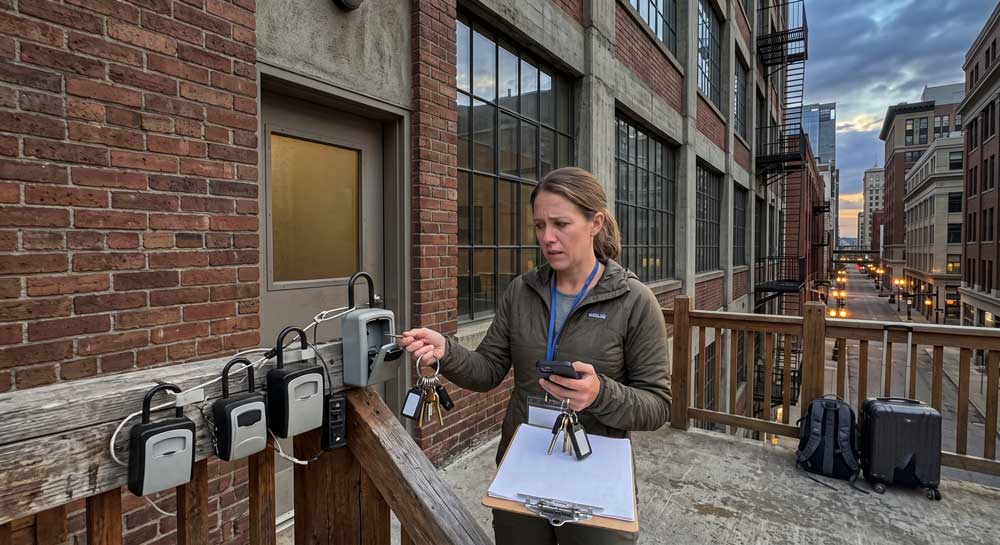
Vous remarquerez de petits boîtiers à clés sur les portes de toutes les villes ayant un marché locatif, et il est juste de se demander si vous devriez faire de même.
Deux choses à savoir.
Cela annonce la propriété. Une boîte sur une porte d'entrée signale que la maison n'est pas occupée en permanence et qu'une clé se trouve à quelques mètres. C'est une préoccupation de sécurité raisonnable, et certains assureurs ont un avis sur la question.
Dans certains endroits, c'est désormais un problème de conformité. Plusieurs villes européennes ont commencé à appliquer des règles contre les boîtes à clés attachées à la propriété publique. Rome a commencé à les retirer des balustrades, portails et façades en janvier 2025, avec des amendes d'environ 400 € par appareil. Florence a agi sur des motifs similaires, et Milan a introduit sa propre interdiction des dispositifs sur le domaine public à partir de janvier 2026. Ces mesures ciblent les dispositifs fixés aux surfaces publiques et aux façades protégées, et non l'idée de garder un double, mais si vous vivez dans un centre historique, il est utile de vérifier avant de percer.
Pour une maison privée, sur votre propre mur, hors de vue, rien de tout cela ne s'applique. Ne le mettez simplement pas sur la porte d'entrée sous prétexte que tout le monde le fait.
Conseils pratiques
Faites faire deux doubles, pas un seul. Donnez-en un et gardez l'autre quelque part de judicieux. Les doubles se perdent.
Testez le double avant d'en avoir besoin. La reproduction de clés bon marché est véritablement incohérente, et un double qui ne tourne pas n'est pas un double. Essayez-le dans la serrure le jour même où vous l'obtenez.
Gardez une liste de qui en possède un. Une courte liste sur votre téléphone. Lorsque quelqu'un n'a plus besoin d'accès, demandez-lui de le restituer.
Refaites les clés lorsque la liste devient floue. Si vous ne pouvez pas dire avec certitude qui détient une clé de votre maison, un serrurier qui re-cylindre la serrure est moins cher qu'un cambriolage et bien moins cher qu'une nouvelle porte.
Ne mettez jamais votre adresse sur le porte-clés. Jamais. Si vous voulez qu'il puisse être retrouvé en cas de perte, utilisez plutôt un numéro de téléphone ou un traceur.
Quand un seul double ne suffit plus
Tout ce qui précède suppose une seule maison et une poignée de personnes de confiance. Si vous avez commencé à gérer l'accès plutôt que de simplement garder un double, le problème change de forme.
Le signal n'est pas le nombre de propriétés. C'est lorsque vous ne pouvez plus répondre à deux questions : qui a actuellement accès, et qui est entré la semaine dernière.
Un double de clé confié à un voisin répond facilement aux deux questions. Un code partagé avec trois entreprises de nettoyage, un bricoleur, une agence immobilière et un ensemble rotatif de locataires ne répond à aucune, car une boîte mécanique ne peut pas distinguer les personnes et ne peut pas garder de trace.
C'est à ce stade que les clés cessent d'être une affaire domestique pour devenir une infrastructure. C'est ce que Keycafe gère : un accès accordé à une personne nommée pour une période définie, enregistré à la collecte et au retour, et révocable en quelques secondes sans changer de serrure.
Pour une seule maison et un seul double, cependant, la réponse honnête est plus simple. Faites-en deux, donnez-en un à un voisin et ne le mettez pas sous le paillasson.
Informations générales uniquement, et non des conseils en matière de sécurité ou d'assurance. Vérifiez votre police d'assurance habitation avant d'installer un coffre à clés, car certains assureurs ont des exigences spécifiques. Les règles concernant la fixation de dispositifs de stockage de clés sur les bâtiments et les propriétés publiques varient selon les villes et ont récemment changé dans plusieurs centres historiques européens.